
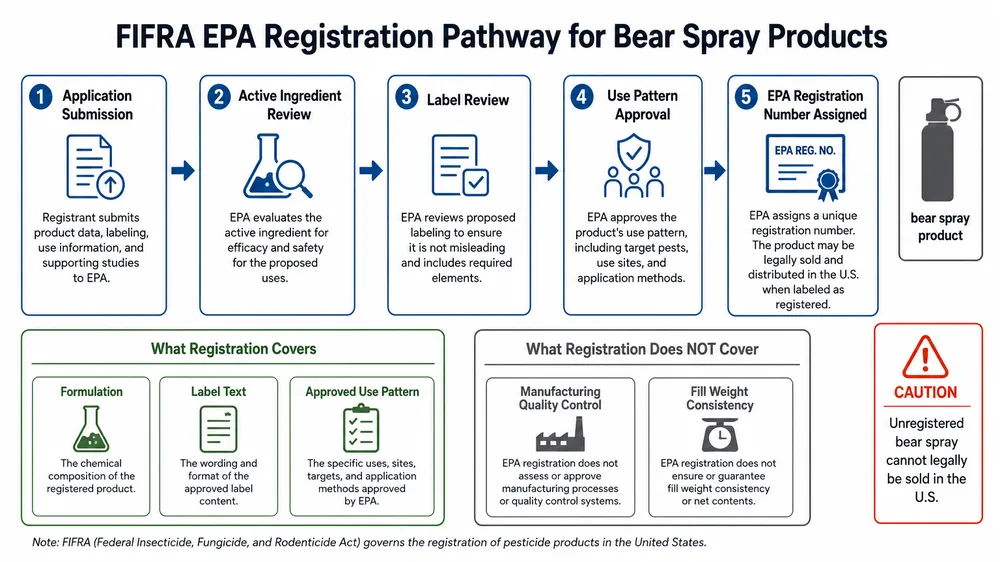
An unregistered bear spray cannot legally be sold in the United States. That's not a technicality — it's the first thing you need to understand before you evaluate any supplier sample or accept any shipment destined for the US market.
We've been manufacturing bear spray for export to North America since 2010. In that time, we've seen buyers get caught with non-compliant stock, and the pattern is almost always the same: the supplier produced a functional product, but the label was wrong. Missing registration number. Incorrect active ingredient statement. No bilingual text where required. The canister works fine. It just can't be sold.
This article walks through what EPA registration actually means under FIFRA, which label elements you need to verify before you commit to an order, and what the compliance failure modes look like from a manufacturer's side.
Why Bear Spray Is a Pesticide Under US Law
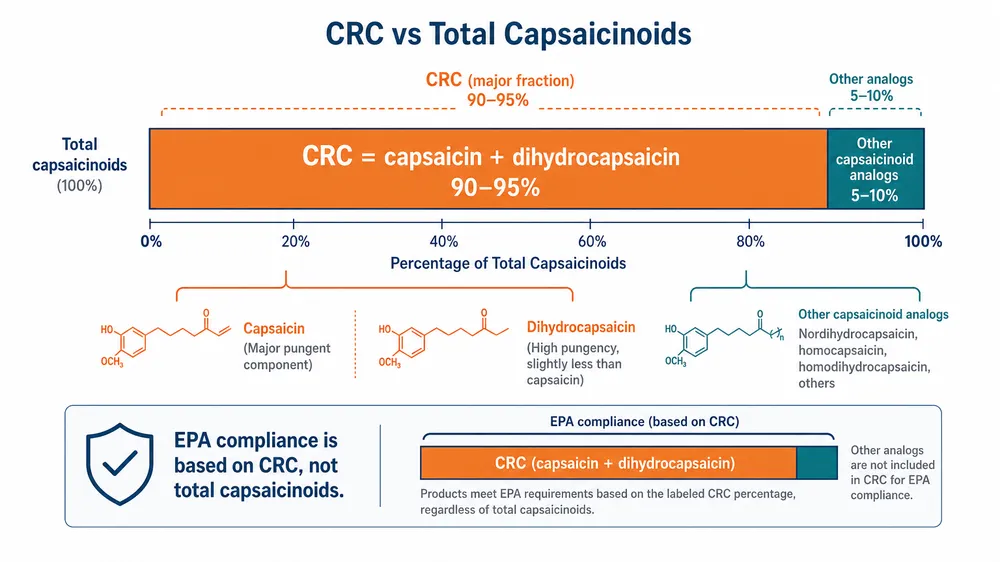
Bear spray is regulated as a pesticide under the Federal Insecticide, Fungicide, and Rodenticide Act (FIFRA), administered by the EPA. The active ingredient — capsaicin and related capsaicinoids (CRC) — is classified as a biochemical pesticide. That classification puts bear spray squarely inside the EPA's registration framework, regardless of how it's marketed or what the end user calls it.
Under FIFRA Section 3, any pesticide sold or distributed in the United States must be registered with the EPA before it enters commerce. Registration is product-specific: it covers the formulation, the label, the use pattern, and the active ingredient concentration. A supplier who changes the CRC percentage, the carrier chemistry, or the label text without updating the registration is technically selling an unregistered product — even if the original registration is still active.
This matters for importers because the registration obligation doesn't disappear at the border. If you import unregistered bear spray, you are the party distributing an unregistered pesticide in US commerce. The EPA's enforcement authority under FIFRA extends to importers and distributors, not just manufacturers.
(The practical enforcement risk varies, but the liability doesn't. Retailers who discover non-compliant stock mid-season will push that liability back up the supply chain — and they'll have the paperwork to do it.)
The FIFRA Registration Framework: What It Covers and What It Doesn't
EPA registration under FIFRA is not a product safety certification in the conventional sense. It's a review and approval of the specific product as described in the registration application — formulation, label, use directions, and all.
When the EPA registers a bear spray product, it approves:
- The active ingredient identity and concentration range
- The inert ingredients (reviewed for safety, though not always publicly disclosed)
- The label text, including use directions, first aid statements, signal word, and precautionary statements
- The use pattern (bear deterrent, not general pest control)
What registration does not cover: manufacturing quality, fill weight consistency, or whether the product in the canister actually matches the registered formulation. That's a separate compliance question — and one that comes back to your supplier's QC process.
The registration number assigned to an approved product is a public record. You can verify any EPA registration number through the EPA's pesticide registration database. If a supplier gives you a registration number that doesn't match the product description in the database, that's a red flag worth stopping for.

The Label Elements You Must Verify Before Accepting a Shipment
This is where most compliance failures happen. The product may be correctly formulated. The supplier may hold a valid EPA registration. But if the physical label on the canister doesn't match the registered label exactly, the product is non-compliant.
Here are the elements to check on every supplier sample before you place an order.
EPA Registration Number and Establishment Number
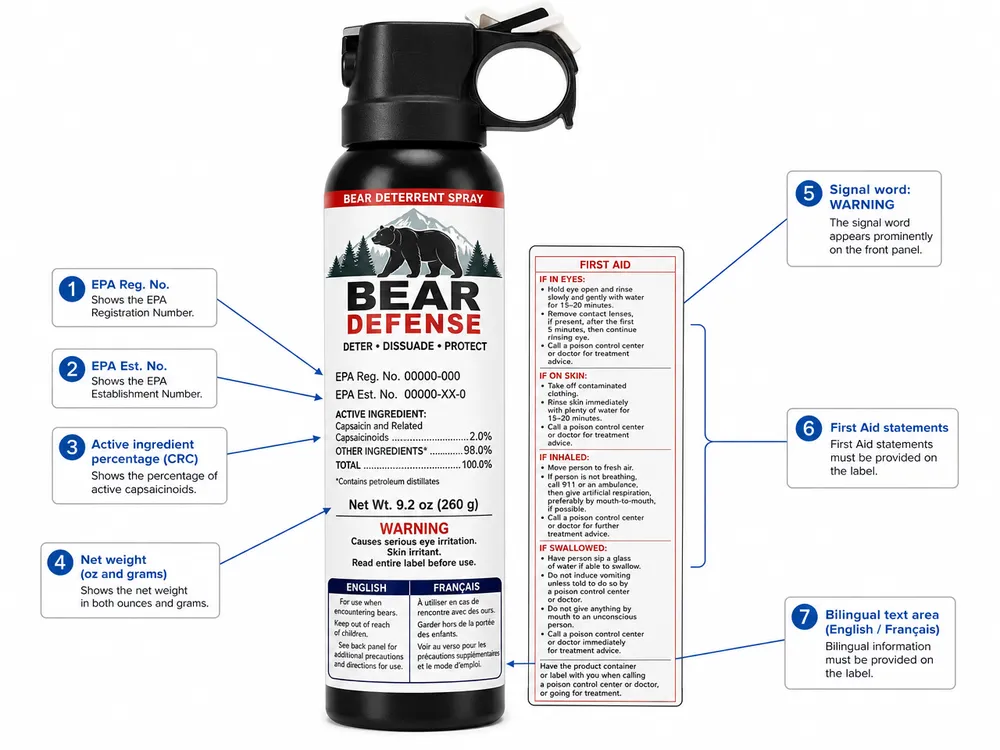
Every EPA-registered bear spray must display the EPA registration number in the format EPA Reg. No. XXXXX-XXXXX. This number identifies the specific registered product. The establishment number (EPA Est. No.) identifies the manufacturing facility where the product was produced.
Both numbers are required on the label. A label with only one, or with a number that doesn't match the EPA database, is non-compliant. We print both numbers directly into our label artwork at the design stage — not as a sticker or secondary print run — because any label that goes through our press without those numbers fails the pre-print check.
Active Ingredient Statement: CRC Percentage
The label must state the active ingredient as "Capsaicin and Related Capsaicinoids" with the percentage by weight. The EPA's registered concentration range for bear spray is 1.0% to 2.0% CRC. Products outside that range — either below 1.0% or above 2.0% — are not registered for use as bear deterrents under current EPA approvals.
The percentage on the label must match the registered formulation. If a supplier tells you their product is "2% CRC" but the label reads "1.0%," one of those numbers is wrong. Either the label is incorrect, or the supplier is misrepresenting the formulation. Either way, you need a Certificate of Analysis from an accredited lab before you accept the shipment.
We run HPLC testing on every incoming capsaicin batch and on finished product samples from each production run. The CoA we provide with each shipment reflects actual measured concentration, not the nominal spec. (Buyers who've dealt with suppliers who only provide nominal specs — without lab data — tend to appreciate the difference after the first time they get a non-compliant batch.)
Net Weight and Net Contents
The label must state the net weight of the product in both US customary and metric units. For bear spray, this is typically expressed in ounces and grams. The stated weight must match the actual fill weight within the tolerance specified in the registration.
Fill weight variance is one of the most common QC failures in aerosol manufacturing. A canister that's consistently 5% underfilled doesn't just fail the label claim — it may fall below the minimum net contents required for the registered use pattern. Our automated gravimetric filling system holds ±1g tolerance across a full production run, which keeps every canister within the labeled weight range.
Signal Word
Bear spray labels are required to carry a signal word — either CAUTION, WARNING, or DANGER — based on the acute toxicity profile of the formulation. Most bear spray products carry CAUTION or WARNING. The signal word must appear prominently on the front panel of the label.
A label missing the signal word, or with the wrong signal word for the registered formulation, is non-compliant. This is a straightforward check, but we've seen supplier samples where the signal word was present on the original label artwork but dropped during a label revision. Always check the physical sample, not just the artwork file.
First Aid and Precautionary Statements
The registered label includes specific first aid statements and precautionary language approved by the EPA. These cannot be modified, abbreviated, or omitted. If a supplier has shortened the first aid text to save label space, the label no longer matches the registered version.
This is an area where private-label buyers sometimes run into trouble. They want a cleaner label design, so they ask the supplier to trim the regulatory text. The supplier obliges. The result is a label that looks better but is no longer compliant with the registered version. We push back on those requests — not because we're inflexible, but because the label text is part of the registration, and changing it without an EPA amendment creates a compliance problem that lands on the importer.
Bilingual Requirements
For products sold in certain US markets — particularly California and other states with significant Spanish-speaking populations — bilingual labeling (English and Spanish) may be required by state law or by retailer specification. Some major outdoor retail chains require bilingual labels as a standard listing condition.
The EPA registration itself may or may not require bilingual text, but your downstream retail requirements often do. We include bilingual label text as standard on our North America export packaging, because the cost of adding it at the label printing stage is negligible compared to the cost of a retailer rejection or a relabeling project after the container arrives.
Label Verification Checklist for Importers
Before accepting a supplier sample for a US-market order, run through this checklist:
| Label Element | What to Check | Where to Verify |
|---|---|---|
| EPA Reg. No. | Present, format EPA Reg. No. XXXXX-XXXXX | EPA pesticide database |
| EPA Est. No. | Present, matches manufacturing facility | EPA establishment database |
| Active ingredient | "Capsaicin and Related Capsaicinoids," 1.0%–2.0% CRC | Matches CoA from accredited lab |
| Net weight | Stated in oz and grams, matches fill spec | Weigh sample canisters |
| Signal word | CAUTION, WARNING, or DANGER — present on front panel | Physical label check |
| First aid statements | Complete, unabbreviated, matches registered text | Compare to EPA-registered label |
| Use directions | "Bear deterrent" use pattern, not general pest control | Physical label check |
| Bilingual text | English/Spanish if required by retailer or state | Confirm with your retail accounts |
| UPC | Present and scannable if required for retail | Scan test |
Request the EPA registration number from your supplier before you order samples. Look it up in the EPA database and confirm the registered label matches what's on the physical canister. If the supplier can't provide the registration number, or if the number doesn't match the product description in the database, stop there.
What Happens When the Label Is Wrong
The consequences of non-compliant labeling are not theoretical. They play out in specific, costly ways.
Import refusal at the port of entry. US Customs and Border Protection works with the EPA to screen pesticide imports. A shipment of bear spray without a valid EPA registration number on the label can be refused entry. You're looking at storage costs, potential destruction of the shipment, and the loss of the product cost — with no recourse against the supplier unless your purchase contract specifically addresses compliance liability.
Retailer delisting. Major outdoor retailers — REI, Bass Pro, Cabela's, and similar accounts — run compliance checks on pesticide products. A non-compliant label discovered during a retailer audit can result in immediate delisting and a chargeback for the cost of pulling the product from shelves. We've heard from buyers who've been through this. It's an expensive lesson.
Recall liability. If non-compliant product reaches consumers and the EPA initiates a recall or stop-sale order, the importer and distributor are in the enforcement chain. FIFRA civil penalties for distributing unregistered pesticides can reach $5,000 per violation per day for commercial entities. The EPA's enforcement history on pesticide labeling is real — it's not a risk that only applies to large companies.
Downstream warranty and return exposure. Even without formal enforcement action, a retailer who discovers non-compliant stock mid-season will return it. Your return authorization process, your freight costs, and your margin on that order are all at risk.
The common thread in all of these scenarios: the importer bears the cost, not the supplier. Your purchase contract can shift some of that risk back to the supplier, but only if you've documented the compliance requirements in the order spec and the supplier has explicitly warranted compliance. Most standard purchase orders don't include that language.
How to Request and Verify EPA Registration Documentation from a Supplier
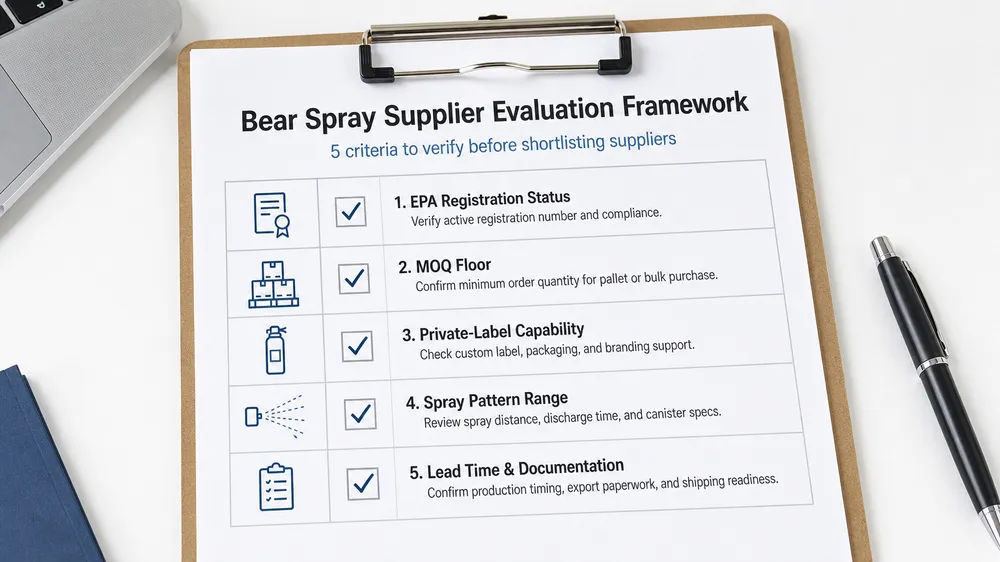
When you're evaluating a new supplier for US-market bear spray, the documentation request should happen before you discuss pricing or MOQ. Here's what to ask for:
1. EPA registration number. Ask for the full registration number in EPA Reg. No. XXXXX-XXXXX format. Look it up in the EPA's pesticide product label system (PPLS) at the EPA website. Confirm the registrant name, the active ingredient, and the registered concentration match what the supplier is offering.
2. Copy of the registered label. The EPA maintains copies of registered labels in the PPLS database. Compare the registered label to the physical label on the supplier's sample. They should match exactly. Any differences — even minor formatting changes — indicate the label has been modified without an EPA amendment.
3. Certificate of Analysis for active ingredient. Request a CoA from an accredited third-party laboratory showing the CRC concentration of the specific batch you're evaluating. The CoA should reference the batch number and the test method (HPLC is standard). A supplier who can only provide a nominal spec without lab data is a supplier whose QC process you can't verify.
4. EPA establishment number. Confirm the establishment number on the label matches the facility where the product was manufactured. If the supplier uses a contract manufacturer, the establishment number should reflect the actual production facility, not the registrant's office address.
5. SGS or third-party audit report. For buyers who need additional documentation for their import process, a third-party audit report from SGS or a similar body provides independent verification of the manufacturing facility's quality system. We make our SGS audit reports available on request — it's part of the standard documentation package for North America export orders.
For buyers sourcing bear spray for the first time, or switching suppliers after a compliance issue, this documentation review is the right place to start. It takes less time than a failed import clearance.
How Label Compliance Works at the Production Stage
There's a difference between a supplier who treats EPA label compliance as a documentation exercise and one who builds it into the production process. From where I sit on the production floor, the difference shows up in how label errors get caught — or don't.
At SOHAPI, label compliance is part of the pre-production checklist, not a post-production review. Before any label goes to print, our compliance team compares the artwork against the registered label text element by element: registration number, establishment number, active ingredient statement, signal word, first aid text, net weight, and bilingual requirements. The artwork doesn't go to the press until that check is signed off.
During production, the post-label inspection checkpoint includes a visual check and a barcode scan on every canister. If a label is misaligned, missing text, or has a barcode that doesn't scan, it gets pulled before it reaches the packaging stage. We don't rely on end-of-line sampling for label compliance — by the time you're sampling at the end of the line, you've already produced a lot of non-compliant units.
For private-label buyers, we provide a label proof with the EPA registration text pre-populated before we finalize the artwork. The buyer reviews the design; we confirm the regulatory text is complete and correct. That review happens before the label film is made, not after the first production run. (We've had buyers come to us after a previous supplier produced 10,000 units with a label error that wasn't caught until the retailer's compliance team flagged it. The relabeling cost was significant. The relationship cost was worse.)
Our export packaging for North America includes EPA registration text, bilingual English/Spanish requirements, and UPC as standard — not as add-ons that require a separate specification. The goal is that your containers arrive shelf-ready, with the compliance documentation already in the shipment file.
You can review our bear spray certifications for the full documentation set we provide with North America export orders, including ISO 9001:2015, CE, and SGS audit reports.
Frequently Asked Questions
Can I sell bear spray in the US if it's manufactured overseas?
Yes, but the product must be registered with the EPA under FIFRA before it enters US commerce. The registration can be held by the foreign manufacturer, a US importer of record, or a US distributor — but someone in the supply chain must hold a valid EPA registration for the specific product. If you're importing under a supplier's existing registration, confirm that the registration covers the exact formulation and label you're importing. A registration held by the manufacturer does not automatically cover a private-label version with a different label.
What's the difference between the EPA registration number and the establishment number?
The registration number (EPA Reg. No.) identifies the specific registered product — the formulation and label approved by the EPA. The establishment number (EPA Est. No.) identifies the physical facility where the product was manufactured. Both are required on the label. A product manufactured at a different facility than the one listed in the establishment number is technically non-compliant, even if the registration is valid.
Does the EPA registration cover the entire concentration range, or a specific percentage?
EPA registrations for bear spray typically cover a concentration range (1.0%–2.0% CRC) rather than a single fixed percentage. The label must state the actual concentration of the specific product, and that concentration must fall within the registered range. A product labeled at 1.5% CRC must actually contain 1.5% CRC — not 1.2%, not 1.8%. The CoA from your supplier should confirm the measured concentration matches the label claim.
What happens if I receive a shipment and discover the label is non-compliant after it's already in my warehouse?
Stop distribution immediately. Distributing a non-compliant pesticide after you're aware of the issue increases your enforcement exposure. Contact the supplier to document the non-compliance and your stop-distribution decision. Depending on the nature of the error, you may be able to relabel the product if the formulation itself is compliant and you can obtain an amended label from the registrant. Consult with a regulatory attorney before making any distribution decisions on stock you believe may be non-compliant.
Does SOHAPI hold its own EPA registration, or does the buyer need to arrange registration?
This depends on the order type. For standard SKUs we supply to North America buyers, the EPA registration is in place and the label is compliant. For private-label orders where the buyer wants their own brand name and label design, the registration situation depends on whether the buyer wants to hold the registration themselves or source under an existing registration. We work through this with buyers during the pre-order consultation — it's a question worth resolving before you finalize the label design, not after. Contact us to discuss your specific situation.
How do I verify a supplier's EPA registration number before placing an order?
The EPA maintains a public database of registered pesticide products called the Pesticide Product Label System (PPLS). You can search by registration number, registrant name, or active ingredient. The database shows the registered label, the registrant, the active ingredient, and the registration status. If a supplier gives you a registration number that returns no results, or returns a different product than what you're being offered, that's a compliance problem you need to resolve before the order is placed.
Sourcing Decisions That Reduce Compliance Risk
EPA label compliance is not a one-time check. It's a sourcing decision that starts with supplier selection and runs through every order.
The suppliers who create the least compliance risk for importers are the ones who treat label compliance as a production process, not a documentation exercise. That means pre-print label review against the registered text, in-process label inspection during production, and a complete documentation package — registration number, CoA, SGS report — included with every shipment.
When you're evaluating suppliers for bear spray destined for the US market, the label compliance question is worth asking directly: "Show me your registered label and your pre-print review process." A supplier who can answer that question with specifics — not just "we're EPA registered" — is a supplier whose compliance process you can actually rely on.
For buyers who want to understand the formulation side of compliance — specifically how bear spray capsaicin concentration affects both efficacy and regulatory status — that's a separate but related question worth working through before you finalize your product spec.
If you have a specific US-market sourcing requirement and want to confirm EPA registration coverage before committing to an order, send us your target market, canister size, and any existing label spec. We'll confirm registration coverage and provide a sample label for review.