
The most common sourcing mistake we see from first-time bear spray importers isn't choosing the wrong canister size or the wrong spray pattern. It's misreading the concentration figure on the spec sheet — and not realizing it until the product is already on a retail shelf or flagged at customs.
The confusion almost always comes down to one thing: total capsaicinoids vs. CRC. These are two different measurements, they produce two different numbers, and the EPA cares about only one of them. If your supplier quotes you a concentration figure without specifying which one, you don't actually know what you're buying.
This article walks through the distinction, how to read a bear spray CoA against EPA label requirements, and where in the supply chain non-compliant stock typically originates. We'll also explain how we control concentration at the formulation stage — because that's where the compliance risk is actually managed, not at the end of the line.
CRC vs total capsaicinoids: the number that determines compliance
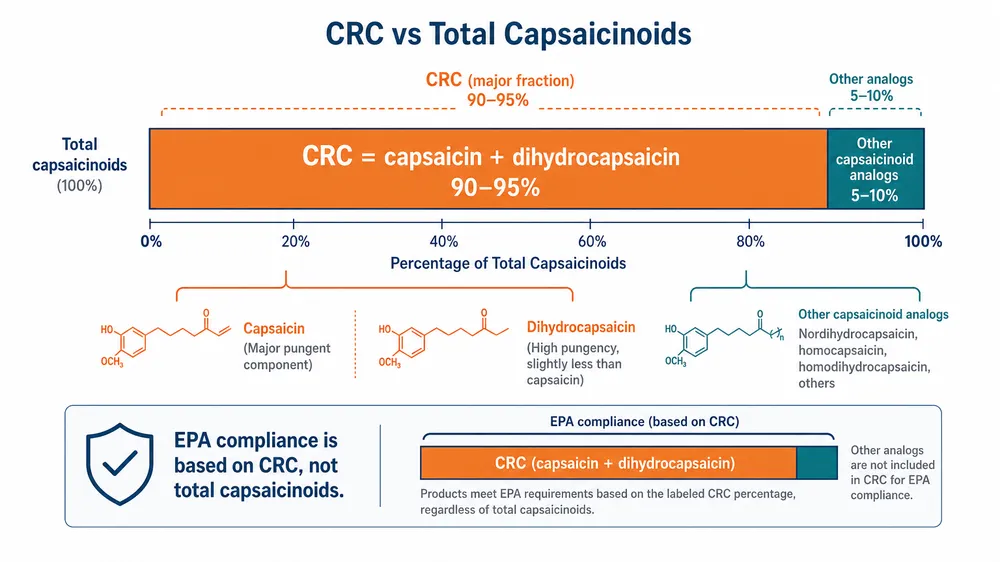
Bear spray's active ingredient is capsaicin and related capsaicinoids — the compounds responsible for the irritant effect. But "capsaicinoids" is a family of compounds, not a single molecule. The group includes capsaicin, dihydrocapsaicin, nordihydrocapsaicin, homocapsaicin, homodihydrocapsaicin, and several minor analogs.
Total capsaicinoids is the sum of all of these. It's the broader measurement.
CRC (capsaicin-related compounds) is a narrower subset — typically capsaicin and dihydrocapsaicin, which together account for roughly 90–95% of the biological activity in a well-formulated product. The EPA's bear spray registration requirements are written around CRC, not total capsaicinoids.
The EPA requires a minimum of 1.0% CRC by weight for a product to qualify as a bear deterrent under FIFRA registration. The practical ceiling most US-market products target is 2.0% CRC, which is where the major retail brands sit. Products above 2% CRC exist but require separate registration review.
Here's where the confusion enters: a supplier quoting "2% capsaicinoids" may be reporting total capsaicinoids, not CRC. Depending on the raw material source and extraction method, total capsaicinoids can run 10–20% higher than the CRC fraction. A product with 2.0% total capsaicinoids might have only 1.7–1.8% CRC — which still clears the 1% floor but would be mislabeled if the label claims 2% CRC.
(We've seen this exact scenario in incoming samples from buyers who were switching suppliers. The previous supplier's CoA said "2% capsaicin" — no further specification. The HPLC result came back at 1.72% CRC. Technically compliant, but not what the label said.)

What the EPA actually requires on the label
The EPA's bear repellent registration framework (under FIFRA) sets the following minimum requirements for a product to be labeled and sold as a bear deterrent in the US market:
| Requirement | Minimum / Specification |
|---|---|
| Active ingredient | Capsaicin and related capsaicinoids (CRC) |
| Minimum CRC concentration | 1.0% by weight |
| Minimum net weight | 7.9 oz (225 g) |
| Minimum spray duration | 6 seconds continuous discharge |
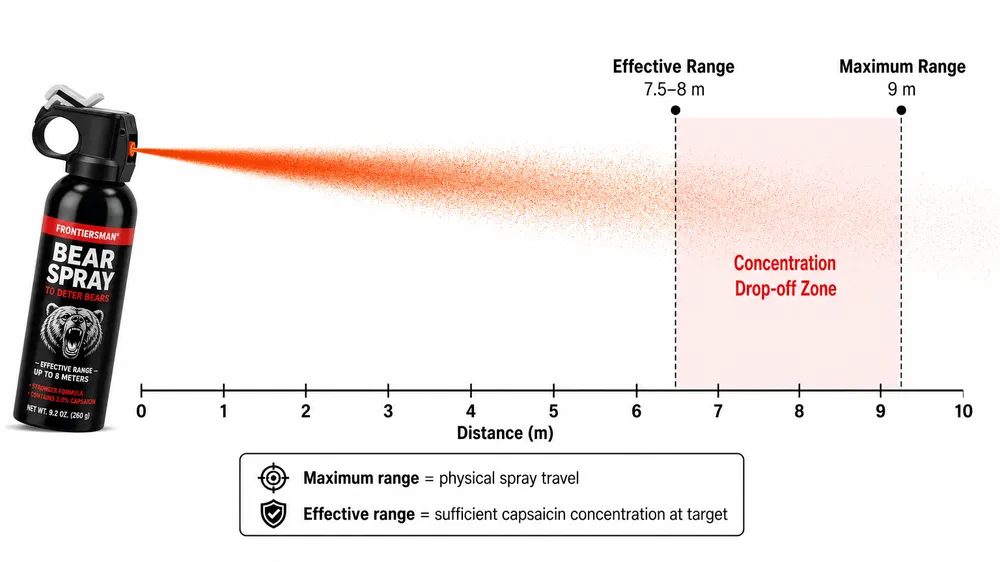
| Minimum effective range | 25 feet (7.6 m) |
| Label language | Must state EPA registration number, active ingredient %, net weight, and directions for use |
The label must state the CRC percentage — not total capsaicinoids, not "capsaicin content," not a generic "active ingredient" figure. If your product's label says "2.0% Capsaicin and Related Capsaicinoids" and the CoA shows 1.85% CRC, you have a labeling violation.
For Canadian buyers, Health Canada's PMRA has its own registration pathway. The concentration requirements are similar in structure but the registration documentation differs. European markets generally don't have a bear spray-specific regulatory framework, but products sold as deterrents still need to meet the concentration claims on the label under general consumer product law.
If you're sourcing for multiple markets, the US EPA requirement is the most specific and the most commonly audited — it's the right baseline to build your spec around. See our article on EPA-registered bear spray for a full breakdown of the registration documentation requirements.
How to read a bear spray CoA: the fields that matter
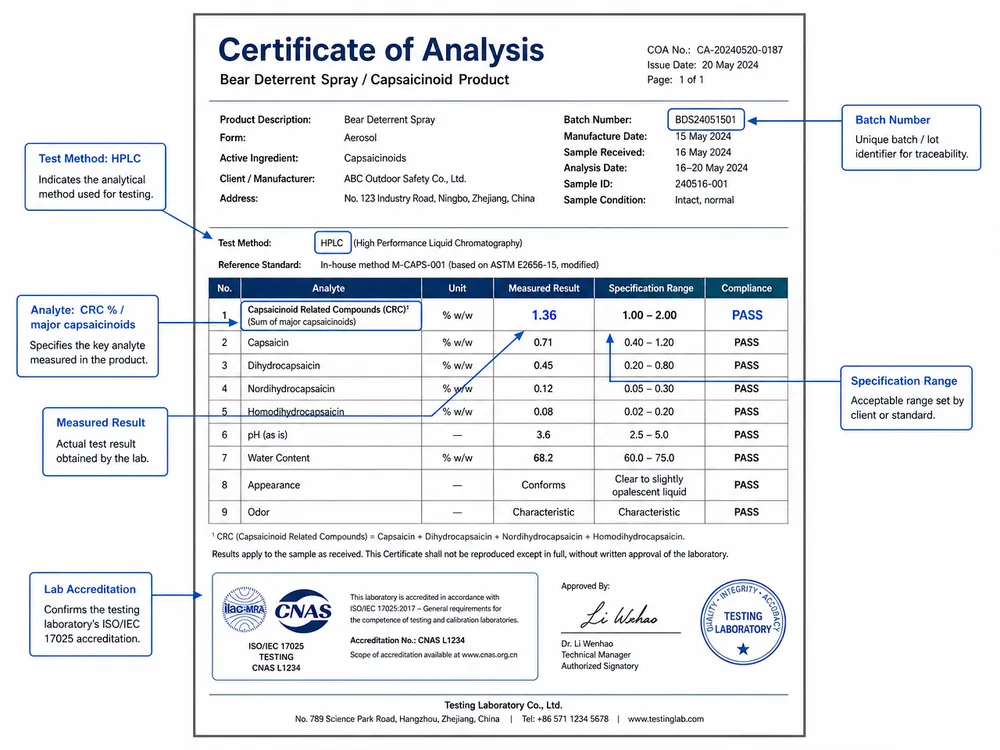
A Certificate of Analysis from a bear spray manufacturer should contain at minimum:
- Product name and batch/lot number
- Test method — HPLC is the standard for capsaicin quantification; UV spectrophotometry is less precise and more prone to interference from carrier compounds
- Analyte reported — must specify CRC or individual compound names (capsaicin, dihydrocapsaicin), not just "capsaicinoids"
- Result — expressed as % by weight
- Specification range — the acceptable window (e.g., 1.8–2.2% CRC)
- Pass/Fail determination
- Testing laboratory — in-house or third-party, with accreditation noted
- Date of analysis
The fields that most commonly mislead buyers:
"Capsaicin content" without method specification. This could be HPLC-measured CRC, total capsaicinoids by UV, or an estimate from the raw material supplier's certificate. Ask which.
Spec range stated as a single number. A CoA that says "2.0% capsaicin" with no range is reporting a nominal target, not a verified batch result. A real batch result has a measured value and a specification window.
Third-party lab name without accreditation. Any lab can issue a document that looks like a CoA. The ones that matter for import documentation are ISO/IEC 17025-accredited labs. SGS, Intertek, and Bureau Veritas are the names you'll see most often in international trade.
Where non-compliant stock originates
Non-compliant bear spray doesn't usually come from a manufacturer deliberately cutting concentration. It comes from process gaps that nobody caught — and the most common ones are predictable.
Batch variance in the raw material. Capsaicin concentrate is an agricultural extract. The CRC fraction varies between batches depending on the pepper source, extraction method, and storage conditions. A supplier who doesn't test incoming concentrate — or tests only the first batch from a new supplier — is running on the assumption that every batch matches the spec. That assumption fails regularly.
Concentration drift during formulation. The capsaicin concentrate is blended with a carrier (typically a petroleum-based or water-miscible solvent) and a propellant system. If the blend ratio drifts — because of a metering pump calibration issue, a temperature change affecting viscosity, or a manual addition error — the finished concentration moves with it. We control this at the formulation stage with in-process checks before the batch goes to the filling line. Catching it here costs an hour. Catching it after 10,000 units are filled costs a container.
Fill weight underage. Even if the formulation is correct, a canister that's 5% underfilled delivers 5% less active ingredient per discharge. At 1.0% CRC nominal, a 5% underfill puts the effective concentration below the EPA minimum. Our filling line runs automated gravimetric control to ±1g tolerance across the full production run — that's the spec we hold, and it's documented in the batch record.
Documentation gaps in the trading company layer. This is the one that's hardest to catch from the buyer's side. A trading company sourcing from multiple factories may consolidate CoAs, reformat documents, or pass through a supplier's nominal spec without verifying the actual batch result. The CoA looks complete. The product may not match it. Factory-direct sourcing eliminates this layer entirely — when you buy from us, the CoA comes from the same facility that made the product, and the batch number on the document matches the batch number on the carton.
How SOHAPI controls capsaicin concentration across the production run
We test capsaicin concentration via HPLC on every incoming batch of capsaicin concentrate — not spot checks, every batch. The HPLC method separates and quantifies capsaicin and dihydrocapsaicin individually, so the CRC figure we report is a measured result, not an estimate from the raw material supplier's certificate.
If an incoming batch falls outside our acceptance window, it doesn't enter the production floor. We've rejected batches from long-term suppliers when the numbers didn't hold. That's not a dramatic policy — it's just how you maintain a consistent finished product when your raw material has natural variance.
At the formulation stage, we run in-process concentration checks before the batch transfers to the filling line. The formulation team targets a specific CRC range — typically 1.9–2.1% for our standard US-market product — with enough headroom above the 1.0% EPA floor that normal production variance doesn't create a compliance risk. (Formulating right at 1.0% is a bad idea. Any downward variance puts you out of spec. We see this in samples from suppliers who are optimizing for raw material cost rather than compliance margin.)
The filling line runs automated gravimetric control. Each canister is weighed during fill, and the system flags and rejects any unit outside the ±1g tolerance window. Fill weight and concentration are the two variables that determine whether a finished canister meets the EPA's active ingredient requirement — we control both, and both are documented in the batch record.
For buyers who need third-party verification, SGS audit reports are available on request. For private-label orders targeting specific regulatory ceilings — US EPA, Canadian PMRA, or EU market requirements — our R&D team adjusts the formulation to hit the target range for your market. That's a standard part of our OEM process, not a special request.
You can review our full bear spray product range to see the standard configurations we ship, or reach out directly if you need a custom concentration spec.
Matching concentration spec to your target market before you order
The practical sourcing question isn't just "is this product compliant?" It's "compliant for which market, at what concentration, with what documentation?"
Here's how the major markets break down:
| Market | Regulatory body | Minimum CRC | Key documentation |
|---|---|---|---|
| United States | EPA (FIFRA) | 1.0% CRC | EPA registration number on label, CoA with HPLC result |
| Canada | Health Canada (PMRA) | ~1.0% CRC (registration-specific) | PMRA registration, bilingual label |
| European Union | No bear spray-specific standard | Label claim must be accurate | CoA, safety data sheet, CE if applicable |
| Other markets | Varies | Varies | Confirm with local import authority |
For US retail, the practical target is 1.8–2.0% CRC. Products at 1.0–1.2% CRC are technically compliant but position poorly against established brands. Products above 2.0% CRC require additional EPA review and are harder to register quickly.
Before placing a bulk order, request the following from any supplier:
- HPLC CoA for the specific batch — not a generic product spec sheet
- Specification range, not just a nominal value — you want to see the acceptable window and the measured result
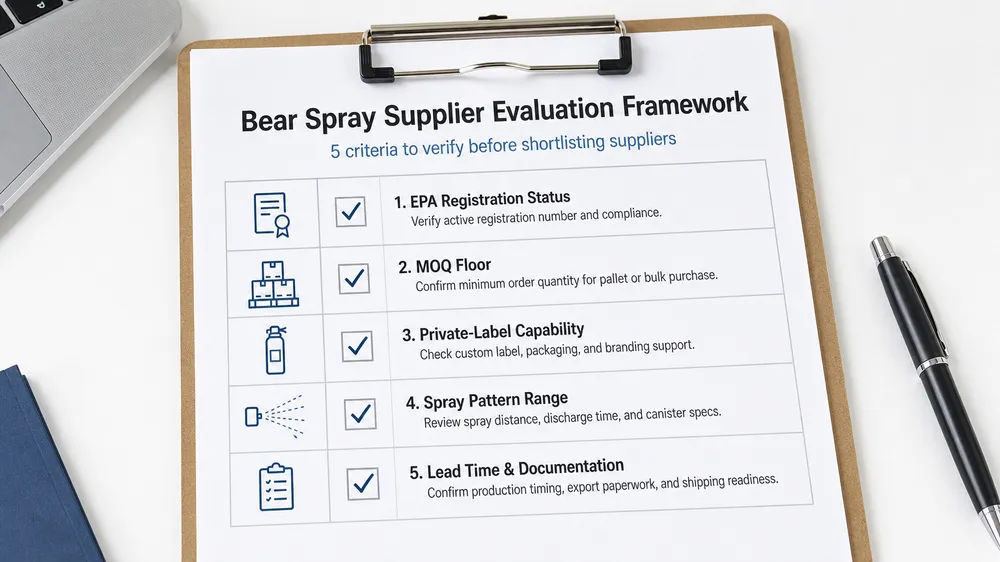
- EPA registration number — if the product is intended for US retail, this must exist before the product ships
- Fill weight tolerance documentation — ask what the gravimetric control spec is and how it's verified
If a supplier can't provide all four, the documentation gap is a sourcing risk. The product may be fine. You just can't verify it.
For a deeper look at how the bear spray repellent capsaicin spec translates into product performance differences at 1% vs 2% CRC, that article covers the efficacy side of the same question.
FAQ
What is the difference between CRC and total capsaicinoids in bear spray?
CRC (capsaicin-related compounds) refers specifically to capsaicin and dihydrocapsaicin — the two primary active compounds. Total capsaicinoids includes these plus several minor analogs. The EPA's bear spray registration requirement is written around CRC, so a supplier quoting total capsaicinoids is giving you a higher number that doesn't directly map to the regulatory standard. Always confirm which measurement a CoA is reporting.
What capsaicin concentration is required for EPA-compliant bear spray?
The EPA requires a minimum of 1.0% CRC by weight. Most US retail products target 1.8–2.0% CRC to provide compliance margin and competitive positioning. Products must also meet minimum net weight (7.9 oz / 225 g), spray duration (6 seconds), and effective range (25 feet) requirements — concentration alone doesn't determine compliance.
How do I verify a supplier's CoA is accurate before placing a bulk order?
Request the CoA for the specific batch you're ordering, not a generic product certificate. Confirm the test method is HPLC (not UV spectrophotometry), that the analyte is specified as CRC or named compounds, and that the testing lab is ISO/IEC 17025-accredited. For high-volume orders, third-party pre-shipment testing through SGS or Intertek is worth the cost — it's cheaper than a customs hold or a product recall.
Can batch variance in capsaicin concentrate cause a compliant product to become non-compliant?
Yes. Capsaicin concentrate is an agricultural extract with natural batch-to-batch variance. A manufacturer who doesn't test every incoming batch is relying on the raw material supplier's certificate, which reflects that supplier's average, not your specific batch. HPLC testing on every incoming batch — not spot checks — is the only way to catch variance before it enters production.
What documentation should I request before importing bear spray to the US?
At minimum: EPA registration number (must appear on the label), HPLC CoA for the production batch, fill weight tolerance documentation, and a safety data sheet. For private-label products, confirm the EPA registration covers your label format and concentration claim. If you're using a trading company, request documentation that traces back to the actual manufacturing facility, not just the trading company's letterhead.
What is the maximum CRC concentration allowed in US-market bear spray?
There's no hard ceiling in the EPA framework, but products above 2.0% CRC require additional registration review and are less common in retail. Most buyers targeting the US market spec at 1.8–2.0% CRC — it's the range where you're clearly above the compliance floor, competitive with established brands, and within the standard registration pathway. If you need a higher-concentration product, that's a formulation project that requires its own EPA review before it can be labeled and sold.
If you're ready to confirm a concentration spec for your target market, request a quote and include your target CRC range, canister format, and destination market — our formulation team will confirm feasibility and send back a detailed quote with CoA documentation.