
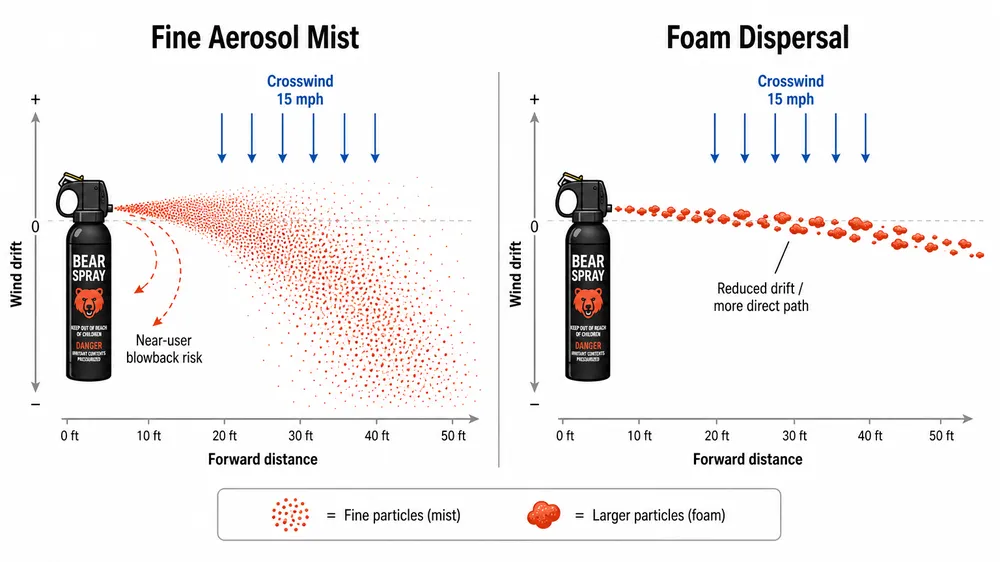
Blowback is the failure mode that doesn't show up in a product spec sheet — but it's the one that ends up in incident reports. A canister that performs perfectly in a controlled discharge test can send active compound back into the user's face at 15 mph crosswind if the spray pattern isn't matched to the deployment environment. For buyers sourcing bear spray for open terrain distribution channels, this is the specification gap that matters most.
Foam dispersal addresses this problem at the physics level, not through marketing language. The mechanics are worth understanding before you decide which SKU to stock.

Why aerosol mist drifts and foam doesn't
The physics comes down to one ratio: mass relative to surface area. Fine aerosol particles — the kind produced by cone and some stream configurations — are small enough that wind force acts on their surface area faster than their mass can resist it. At 10-15 mph crosswind, a fine mist cloud can deflect 30-40 degrees from its intended trajectory within the first few meters of discharge. At 20+ mph, the deflection is severe enough that the cloud reaches the user before it reaches the target.
Foam works differently. The carrier is formulated to a higher viscosity — typically in the range of 2,000-8,000 cP depending on the specific formulation — which means the propellant produces larger, heavier particles rather than a fine mist. Those particles have a much higher mass-to-surface-area ratio. Wind can still affect them, but the force required to deflect them significantly is proportionally higher. A foam discharge in a 15 mph crosswind holds its forward trajectory well enough to remain effective at 4-6 meters, where a cone pattern under the same conditions may be compromised at 2-3 meters.
(The viscosity range matters here — a carrier that's too thin produces particles that behave more like mist, and a carrier that's too thick can reduce discharge range. Getting this balance right is a formulation problem, not a nozzle problem.)
The second factor is cohesion. Foam particles tend to clump rather than disperse independently. This means the cloud maintains a denser, more directional mass rather than spreading into a diffuse haze that wind can redirect. For open terrain use — alpine meadows, coastal tundra, exposed ridgelines — this cohesion is what keeps the active compound on target.
Spray pattern wind sensitivity: foam vs stream vs cone
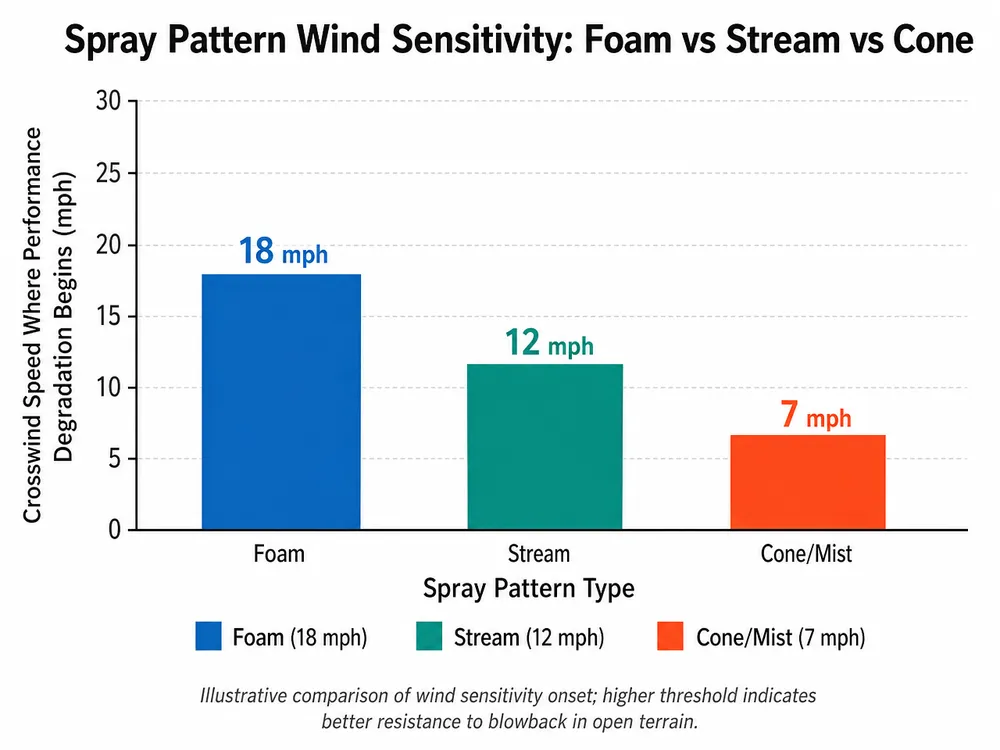
Not all spray patterns respond to wind the same way. The table below gives practical wind speed thresholds where each pattern type starts to show meaningful performance degradation in open terrain conditions.
| Spray Pattern | Particle Characteristics | Wind Sensitivity Onset | Blowback Risk at 15 mph | Effective Range in Wind |
|---|---|---|---|---|
| Cone / Mist | Fine particles, wide dispersion | ~8-10 mph | High | 2-3 m |
| Stream | Narrow, higher-velocity jet | ~12-15 mph | Moderate | 5-7 m |
| Foam | Large, viscous particles, cohesive | ~18-22 mph | Low | 4-6 m |
A few notes on reading this table. Stream patterns hold up better in wind than cone because the higher discharge velocity gives particles more forward momentum before wind force can act on them. But stream has its own trade-off: the narrow pattern requires more accurate aim under stress, which is a real-world deployment problem. Foam gives up some range compared to stream but delivers a wider effective cloud that's more forgiving of aim error — and it does so without the blowback risk that makes cone patterns problematic in exposed conditions.
For buyers deciding between foam and stream for open terrain channels, the question isn't which pattern is "better" — it's which failure mode your end-user market can tolerate less. If your buyers are outfitting guided wilderness operations where users have training, stream is defensible. If you're distributing to general outdoor retail where end-users have minimal training and may be deploying in panic, foam's blowback resistance is the more commercially relevant specification.
The formulation variables that actually control wind resistance
This is where the sourcing conversation gets specific. Wind resistance in a foam bear spray isn't a fixed property — it's a function of three formulation variables that can be tuned independently. Understanding them helps you ask the right questions when evaluating a supplier's foam SKU.
Carrier viscosity is the primary lever. The carrier is the liquid medium that holds the capsaicin compound and interacts with the propellant to produce the spray pattern. Higher viscosity produces larger, heavier foam particles with better wind resistance. Lower viscosity produces finer particles that behave more like a mist. We typically work in the 2,000-8,000 cP range for foam configurations, with the specific target depending on the canister size and intended deployment environment. A 225g canister for alpine use might be formulated toward the higher end of that range; a smaller 150g canister for general outdoor retail might sit lower to preserve discharge range.
Propellant ratio affects both discharge velocity and particle formation. Higher propellant content increases discharge pressure and velocity, which improves range but can fragment the foam into finer particles — reducing the wind resistance advantage. Lower propellant content produces a slower, denser discharge that holds foam cohesion better but shortens effective range. The balance point depends on what you're optimizing for: maximum range or maximum wind resistance. These two properties pull in opposite directions, and any supplier claiming to maximize both simultaneously is either using a very specific canister geometry or not being precise about their specs.
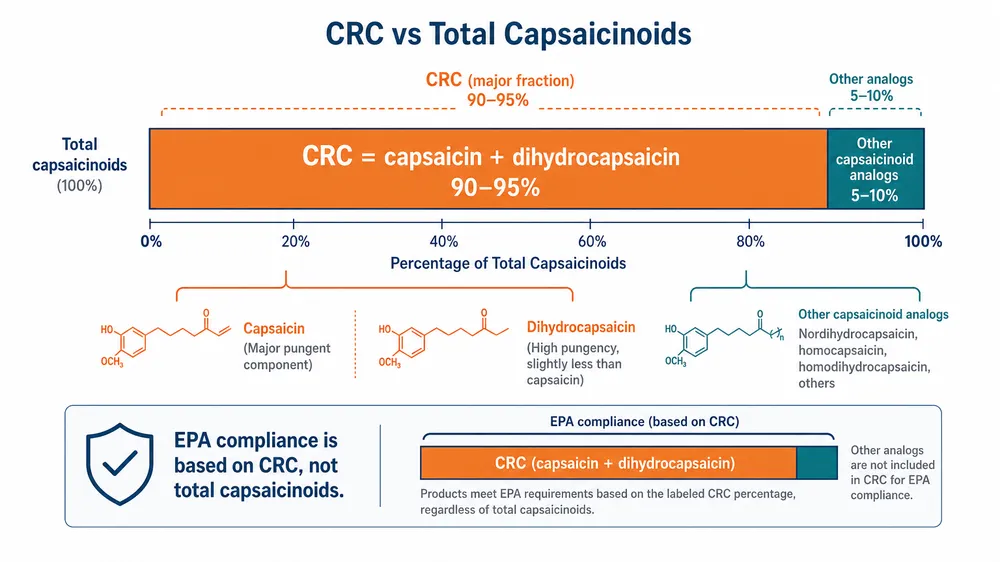
CRC concentration doesn't directly affect wind resistance, but it interacts with the carrier chemistry. Higher capsaicin concentrations require more careful carrier formulation to maintain stability and consistent viscosity across the product's shelf life. A foam formulation that tests well at production may show viscosity drift after 18 months if the carrier chemistry isn't matched to the concentration level. This is a shelf-life risk that shows up in your returns, not in the initial spec sheet.
We've run into all three of these variables in OEM development work. The most common mistake buyers make is specifying CRC concentration and canister size without specifying carrier viscosity — then being surprised when two suppliers' "foam" products behave completely differently in field conditions. If a supplier can't give you a viscosity spec for their foam carrier, that's a gap worth closing before you place an order.
Open terrain deployment environments and the SKU decision
The procurement question isn't just "does this foam resist wind" — it's "which of my distribution channels actually needs foam, and at what spec level."
Alpine and subalpine terrain is the clearest case for foam. Exposed ridgelines, open bowls, and above-treeline environments regularly see sustained winds of 15-25 mph, with gusts well above that. Cone patterns are genuinely problematic here. Stream patterns are workable but require user training. Foam is the defensible specification for this segment, and buyers supplying mountaineering retailers, alpine guide services, or national park concessionaires should be stocking foam as their primary SKU.
Coastal and tidal flat environments — particularly in areas like coastal Alaska or northern Canada where brown bear encounters occur in open terrain — present similar wind exposure. The added factor here is humidity: foam formulations need to maintain viscosity stability in high-humidity conditions, which is a carrier chemistry consideration worth confirming with your supplier.
Open tundra and boreal transition zones are the environments where the foam vs stream decision is most nuanced. Wind exposure is high, but so is the likelihood of encounters at longer distances where stream's range advantage matters. Some buyers in this segment stock both SKUs and let their retail partners make the recommendation based on specific use case. (We've seen this work well for distributors supplying both guided outfitters and general outdoor retailers from the same catalog — the two segments have genuinely different needs.)
Forest and dense vegetation environments are where foam's wind resistance advantage largely disappears — there's no sustained crosswind in a dense forest. For these channels, stream or cone patterns are typically the better fit, and stocking foam as the primary SKU adds cost without adding meaningful performance benefit.
The internal link between terrain type and SKU selection is something worth building into your sales materials. Buyers who understand why they're specifying foam — not just that it's "wind resistant" — are better positioned to sell it through to their retail partners. For a deeper look at how foam and stream compare across the full range of deployment scenarios, see our post on bear spray foam vs stream.
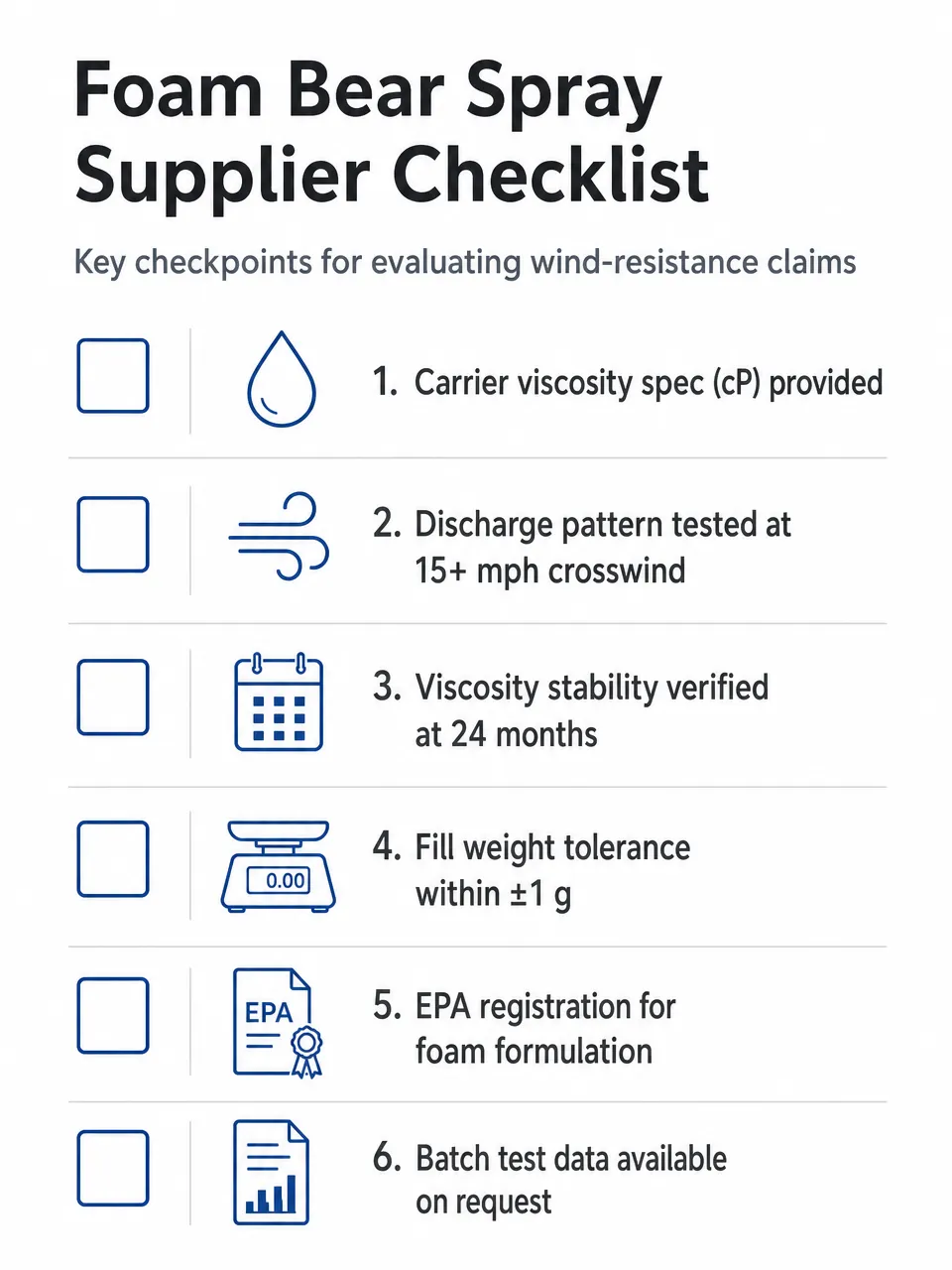
What to ask a supplier before you commit to a foam SKU
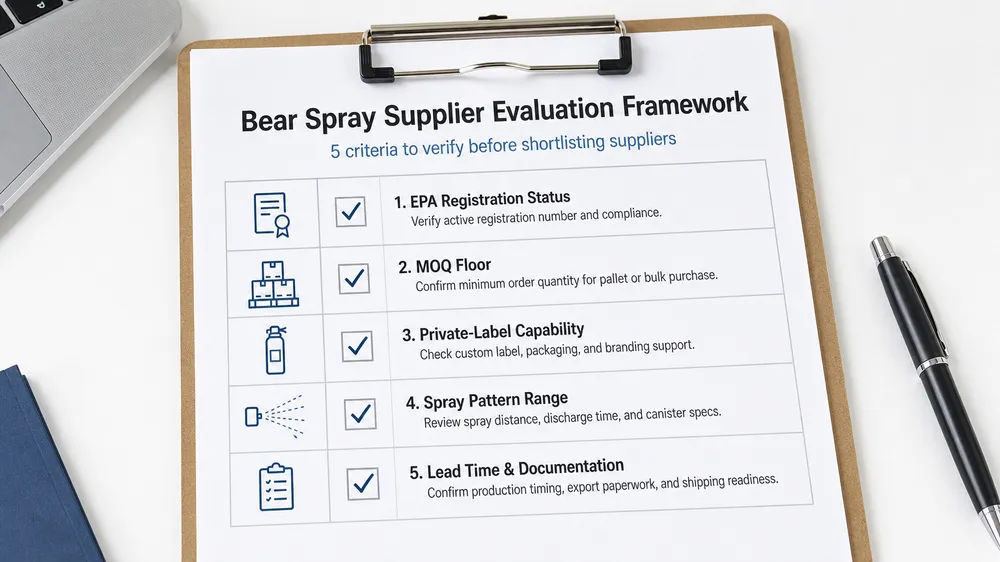
Most of the sourcing risk in foam bear spray comes from vague specifications. "Wind resistant foam" is a marketing claim. The following are the actual data points that tell you whether a foam formulation will perform in open terrain conditions.
Carrier viscosity specification — Ask for the target viscosity in cP and the acceptable tolerance range. If the supplier can't provide this, the formulation isn't controlled tightly enough to guarantee consistent wind resistance across production runs.
Discharge pattern test data at simulated wind speeds — A credible manufacturer can show you discharge pattern documentation at 10, 15, and 20 mph crosswind. This doesn't require a wind tunnel — a controlled fan test with documented methodology is sufficient. What you're looking for is evidence that the supplier has actually tested the product in wind conditions, not just in still air.
Viscosity stability over shelf life — Ask for viscosity data at production and at 24 months (or the product's rated shelf life). Foam that performs well at production but drifts toward lower viscosity over time will show degraded wind resistance in the field. This is a real failure mode, and it's one that shows up in your returns rather than in incoming inspection.
Fill weight tolerance — This applies to all bear spray, but it's worth confirming for foam specifically. A canister that's underfilled by 5% has less propellant, which affects discharge pressure and particle formation. Our filling lines run ±1g tolerance using automated gravimetric control — that's the kind of spec that matters for consistent field performance across a production run.
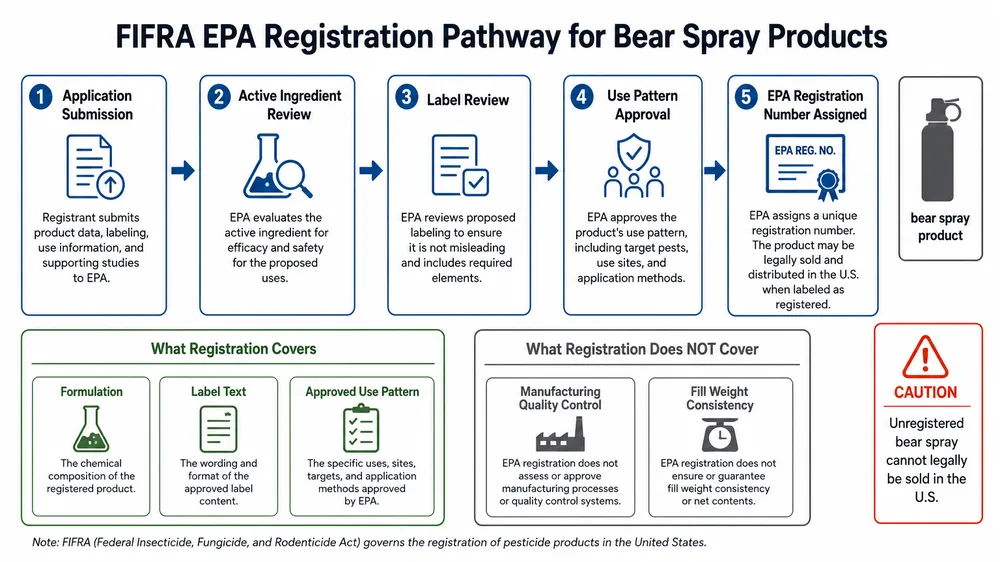
Regulatory documentation — For North American distribution, confirm EPA registration covers the foam formulation specifically. Some suppliers register a base formulation and then modify the carrier for foam without updating the registration. That's a compliance gap that can hold up your import clearance.
Factory-direct sourcing gives you access to this data without going through a distributor who may not have it. When you source through a trading company, you're often getting the spec sheet they received from the factory — which may not include the formulation detail you need to evaluate wind resistance properly. We provide full formulation documentation to OEM buyers as part of the standard sourcing package, because buyers who understand what they're ordering place better orders.
For a full breakdown of the formulation variables that control foam performance, the bear spray foam formulation post covers carrier chemistry, propellant ratio, and fill weight specs in more detail.
Foam formulation customization for OEM buyers
If you're building a private-label foam SKU for a specific distribution channel, the formulation variables above aren't fixed — they're adjustable. Our R&D team handles custom foam formulation development for OEM buyers, and the scope of what can be adjusted is broader than most buyers expect.
Carrier viscosity can be tuned to a specific wind exposure target. If your end-user market is primarily alpine terrain with sustained winds above 20 mph, we can formulate toward the higher viscosity range to maximize foam cohesion. If you're targeting a mixed-terrain market where range matters as much as wind resistance, we can find a balance point that doesn't sacrifice too much of either.
CRC concentration is adjustable within the regulatory ceiling for your target market. For North American distribution, EPA registration requirements set the compliance parameters — we work within those. For European or Southeast Asian markets, the regulatory framework differs, and we can formulate to the applicable standard.
Canister size affects the propellant-to-formula ratio and therefore the discharge characteristics. A 225g canister and a 150g canister with the same formulation will behave differently in the field — the larger canister has more propellant headspace, which affects discharge pressure and foam particle formation. We account for this in the development process rather than treating it as a post-production variable.
Most custom foam formulation projects run 4-6 weeks from spec confirmation to approved sample. Buyers who come in with a clear terrain target, a regulatory market, and a canister size move through the process faster. The development work is handled internally — we don't subcontract formulation to a third-party lab, which means the iteration cycle is faster and the documentation stays in one place.
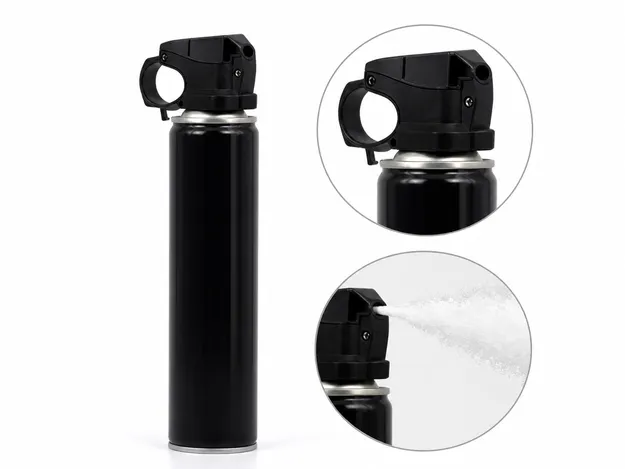
For buyers who want to understand the full range of Bear Spray Foam configurations we produce, the product page covers standard SKU options alongside OEM customization parameters.
Frequently asked questions
Does foam bear spray work in rain or high humidity?
Foam formulations are generally less affected by rain than aerosol mist patterns, because the larger particles don't disperse as readily. High humidity can affect carrier viscosity over time if the formulation isn't stabilized for the storage environment — this is a shelf-life consideration rather than a deployment consideration. For buyers distributing to coastal or high-humidity markets, confirm viscosity stability data at elevated humidity with your supplier before committing to a SKU.
What wind speed is too high for any bear spray pattern?
At sustained winds above 25-30 mph, all spray patterns show significant performance degradation. Foam holds up better than cone or mist at these speeds, but it's not immune. At extreme wind speeds, the practical guidance for end-users is to position themselves upwind of the threat before deploying — which is a training and labeling issue, not a formulation issue. Buyers supplying markets with extreme wind exposure (coastal Alaska, exposed tundra) should include deployment guidance in their retail packaging.
Can I source foam and stream SKUs from the same manufacturer to cover both terrain types?
Yes, and this is a common approach for distributors covering multiple market segments. Running both SKUs from the same manufacturer simplifies your documentation, your import process, and your reorder logistics. We produce both foam and stream configurations across our product range — the formulation and valve engineering are different, but the production standards, QC process, and documentation are consistent across both.
What MOQ applies to custom foam formulations?
Standard foam SKUs are available at lower MOQs. Custom formulation work — where we're adjusting carrier viscosity, CRC concentration, or canister format to your spec — typically requires a minimum run that justifies the development and line setup cost. The specific MOQ depends on canister size and formulation complexity. The right starting point is to send us your terrain target, regulatory market, and volume expectations, and we'll give you a realistic MOQ and development timeline. Request a quote with those details and our team will respond with specifics.
How do I verify a supplier's foam wind resistance claims without field testing?
Ask for discharge pattern documentation at simulated wind speeds — a controlled fan test with documented methodology is the minimum acceptable evidence. Also ask for the carrier viscosity spec and the tolerance range. If a supplier can't provide viscosity data, the formulation isn't controlled tightly enough to guarantee consistent wind resistance. Third-party SGS test reports, where available, add another layer of verification. We make this documentation available to qualified buyers as part of the sourcing review process.
The Bear Spray category page covers our full product range, including standard and OEM foam configurations, with specification details for each SKU.