SOHAPI

DNOOO blank theme is active for local preview.

Bear Spray Foam Wind Resistance: How Foam Dispersal Reduces Blowback Risk in Open Terrain Applications

Blowback is the failure mode that doesn't show up in a product spec sheet — but it's the one that ends up in incident reports. A canister that performs perfectly in a controlled discharge test can send active compound back into the user's face at 15 mph crosswind if the spray pattern isn't matched to the deployment environment. For buyers sourcing bear spray for open terrain distribution channels, this is the specification gap that matters most.

Foam dispersal addresses this problem at the physics level, not through marketing language. The mechanics are worth understanding before you decide which SKU to stock.
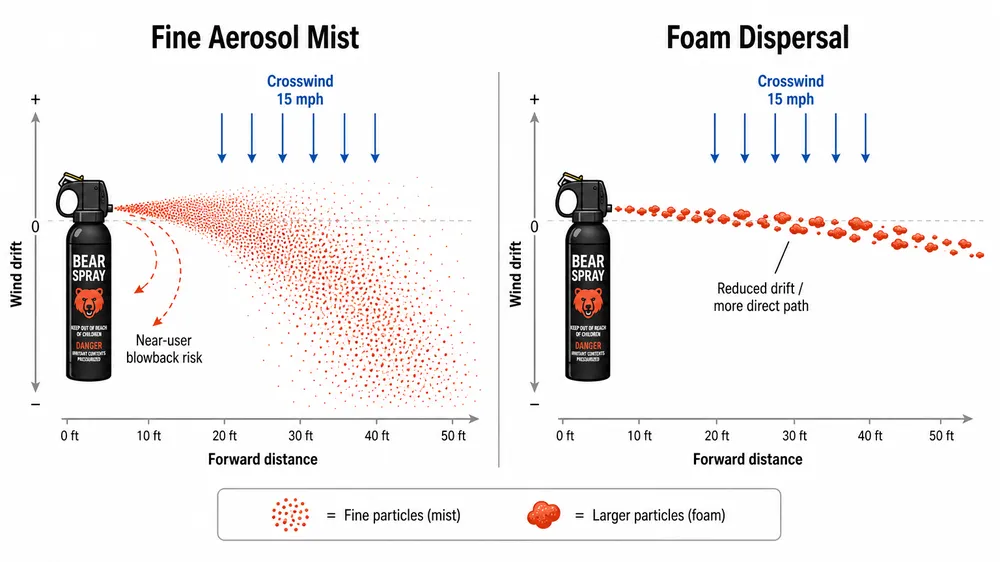
Diagram comparing foam dispersal and aerosol mist drift patterns in crosswind conditions for bear spray

Why aerosol mist drifts and foam doesn't

The physics comes down to one ratio: mass relative to surface area. Fine aerosol particles — the kind produced by cone and some stream configurations — are small enough that wind force acts on their surface area faster than their mass can resist it. At 10-15 mph crosswind, a fine mist cloud can deflect 30-40 degrees from its intended trajectory within the first few meters of discharge. At 20+ mph, the deflection is severe enough that the cloud reaches the user before it reaches the target.

Foam works differently. The carrier is formulated to a higher viscosity — typically in the range of 2,000-8,000 cP depending on the specific formulation — which means the propellant produces larger, heavier particles rather than a fine mist. Those particles have a much higher mass-to-surface-area ratio. Wind can still affect them, but the force required to deflect them significantly is proportionally higher. A foam discharge in a 15 mph crosswind holds its forward trajectory well enough to remain effective at 4-6 meters, where a cone pattern under the same conditions may be compromised at 2-3 meters.

(The viscosity range matters here — a carrier that's too thin produces particles that behave more like mist, and a carrier that's too thick can reduce discharge range. Getting this balance right is a formulation problem, not a nozzle problem.)

The second factor is cohesion. Foam particles tend to clump rather than disperse independently. This means the cloud maintains a denser, more directional mass rather than spreading into a diffuse haze that wind can redirect. For open terrain use — alpine meadows, coastal tundra, exposed ridgelines — this cohesion is what keeps the active compound on target.

Spray pattern wind sensitivity: foam vs stream vs cone

Not all spray patterns respond to wind the same way. The table below gives practical wind speed thresholds where each pattern type starts to show meaningful performance degradation in open terrain conditions.

Spray Pattern Particle Characteristics Wind Sensitivity Onset Blowback Risk at 15 mph Effective Range in Wind
Cone / Mist Fine particles, wide dispersion ~8-10 mph High 2-3 m
Stream Narrow, higher-velocity jet ~12-15 mph Moderate 5-7 m
Foam Large, viscous particles, cohesive ~18-22 mph Low 4-6 m

A few notes on reading this table. Stream patterns hold up better in wind than cone because the higher discharge velocity gives particles more forward momentum before wind force can act on them. But stream has its own trade-off: the narrow pattern requires more accurate aim under stress, which is a real-world deployment problem. Foam gives up some range compared to stream but delivers a wider effective cloud that's more forgiving of aim error — and it does so without the blowback risk that makes cone patterns problematic in exposed conditions.

For buyers deciding between foam and stream for open terrain channels, the question isn't which pattern is "better" — it's which failure mode your end-user market can tolerate less. If your buyers are outfitting guided wilderness operations where users have training, stream is defensible. If you're distributing to general outdoor retail where end-users have minimal training and may be deploying in panic, foam's blowback resistance is the more commercially relevant specification.
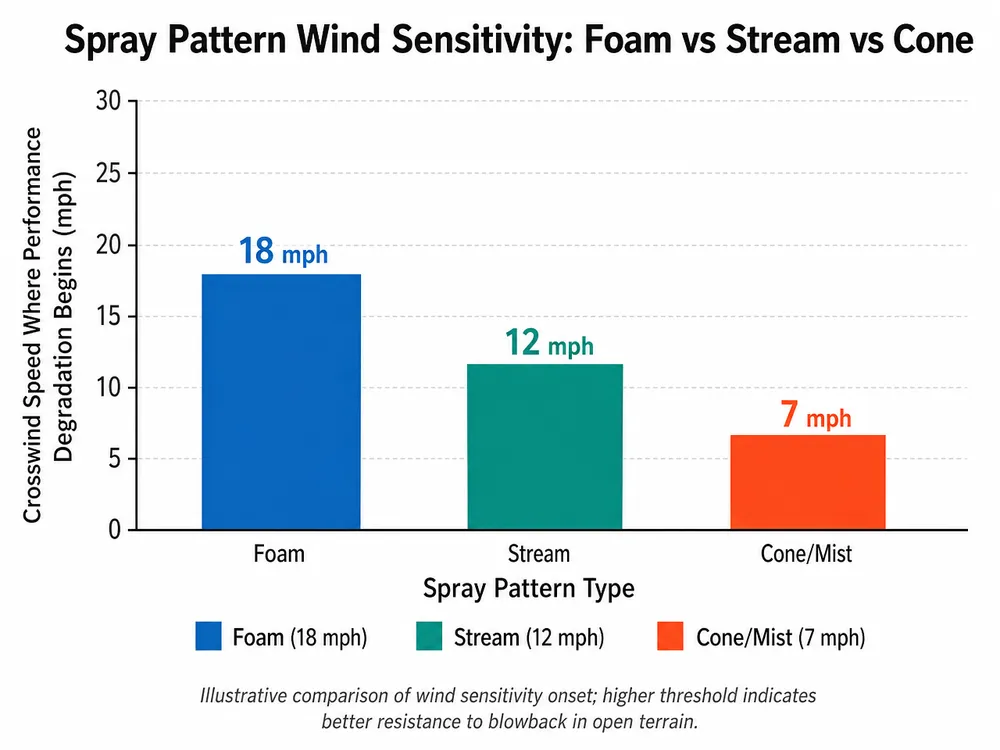
Bar chart comparing wind sensitivity thresholds for foam, stream, and cone bear spray patterns at different wind speeds

The formulation variables that actually control wind resistance

This is where the sourcing conversation gets specific. Wind resistance in a foam bear spray isn't a fixed property — it's a function of three formulation variables that can be tuned independently. Understanding them helps you ask the right questions when evaluating a supplier's foam SKU.

Carrier viscosity is the primary lever. The carrier is the liquid medium that holds the capsaicin compound and interacts with the propellant to produce the spray pattern. Higher viscosity produces larger, heavier foam particles with better wind resistance. Lower viscosity produces finer particles that behave more like a mist. We typically work in the 2,000-8,000 cP range for foam configurations, with the specific target depending on the canister size and intended deployment environment. A 225g canister for alpine use might be formulated toward the higher end of that range; a smaller 150g canister for general outdoor retail might sit lower to preserve discharge range.

Propellant ratio affects both discharge velocity and particle formation. Higher propellant content increases discharge pressure and velocity, which improves range but can fragment the foam into finer particles — reducing the wind resistance advantage. Lower propellant content produces a slower, denser discharge that holds foam cohesion better but shortens effective range. The balance point depends on what you're optimizing for: maximum range or maximum wind resistance. These two properties pull in opposite directions, and any supplier claiming to maximize both simultaneously is either using a very specific canister geometry or not being precise about their specs.

CRC concentration doesn't directly affect wind resistance, but it interacts with the carrier chemistry. Higher capsaicin concentrations require more careful carrier formulation to maintain stability and consistent viscosity across the product's shelf life. A foam formulation that tests well at production may show viscosity drift after 18 months if the carrier chemistry isn't matched to the concentration level. This is a shelf-life risk that shows up in your returns, not in the initial spec sheet.

We've run into all three of these variables in OEM development work. The most common mistake buyers make is specifying CRC concentration and canister size without specifying carrier viscosity — then being surprised when two suppliers' "foam" products behave completely differently in field conditions. If a supplier can't give you a viscosity spec for their foam carrier, that's a gap worth closing before you place an order.

Open terrain deployment environments and the SKU decision

The procurement question isn't just "does this foam resist wind" — it's "which of my distribution channels actually needs foam, and at what spec level."

Alpine and subalpine terrain is the clearest case for foam. Exposed ridgelines, open bowls, and above-treeline environments regularly see sustained winds of 15-25 mph, with gusts well above that. Cone patterns are genuinely problematic here. Stream patterns are workable but require user training. Foam is the defensible specification for this segment, and buyers supplying mountaineering retailers, alpine guide services, or national park concessionaires should be stocking foam as their primary SKU.

Coastal and tidal flat environments — particularly in areas like coastal Alaska or northern Canada where brown bear encounters occur in open terrain — present similar wind exposure. The added factor here is humidity: foam formulations need to maintain viscosity stability in high-humidity conditions, which is a carrier chemistry consideration worth confirming with your supplier.

Open tundra and boreal transition zones are the environments where the foam vs stream decision is most nuanced. Wind exposure is high, but so is the likelihood of encounters at longer distances where stream's range advantage matters. Some buyers in this segment stock both SKUs and let their retail partners make the recommendation based on specific use case. (We've seen this work well for distributors supplying both guided outfitters and general outdoor retailers from the same catalog — the two segments have genuinely different needs.)

Forest and dense vegetation environments are where foam's wind resistance advantage largely disappears — there's no sustained crosswind in a dense forest. For these channels, stream or cone patterns are typically the better fit, and stocking foam as the primary SKU adds cost without adding meaningful performance benefit.

The internal link between terrain type and SKU selection is something worth building into your sales materials. Buyers who understand why they're specifying foam — not just that it's "wind resistant" — are better positioned to sell it through to their retail partners. For a deeper look at how foam and stream compare across the full range of deployment scenarios, see our post on bear spray foam vs stream.

What to ask a supplier before you commit to a foam SKU

Most of the sourcing risk in foam bear spray comes from vague specifications. "Wind resistant foam" is a marketing claim. The following are the actual data points that tell you whether a foam formulation will perform in open terrain conditions.

Carrier viscosity specification — Ask for the target viscosity in cP and the acceptable tolerance range. If the supplier can't provide this, the formulation isn't controlled tightly enough to guarantee consistent wind resistance across production runs.

Discharge pattern test data at simulated wind speeds — A credible manufacturer can show you discharge pattern documentation at 10, 15, and 20 mph crosswind. This doesn't require a wind tunnel — a controlled fan test with documented methodology is sufficient. What you're looking for is evidence that the supplier has actually tested the product in wind conditions, not just in still air.

Viscosity stability over shelf life — Ask for viscosity data at production and at 24 months (or the product's rated shelf life). Foam that performs well at production but drifts toward lower viscosity over time will show degraded wind resistance in the field. This is a real failure mode, and it's one that shows up in your returns rather than in incoming inspection.

Fill weight tolerance — This applies to all bear spray, but it's worth confirming for foam specifically. A canister that's underfilled by 5% has less propellant, which affects discharge pressure and particle formation. Our filling lines run ±1g tolerance using automated gravimetric control — that's the kind of spec that matters for consistent field performance across a production run.

Regulatory documentation — For North American distribution, confirm EPA registration covers the foam formulation specifically. Some suppliers register a base formulation and then modify the carrier for foam without updating the registration. That's a compliance gap that can hold up your import clearance.

Factory-direct sourcing gives you access to this data without going through a distributor who may not have it. When you source through a trading company, you're often getting the spec sheet they received from the factory — which may not include the formulation detail you need to evaluate wind resistance properly. We provide full formulation documentation to OEM buyers as part of the standard sourcing package, because buyers who understand what they're ordering place better orders.

For a full breakdown of the formulation variables that control foam performance, the bear spray foam formulation post covers carrier chemistry, propellant ratio, and fill weight specs in more detail.
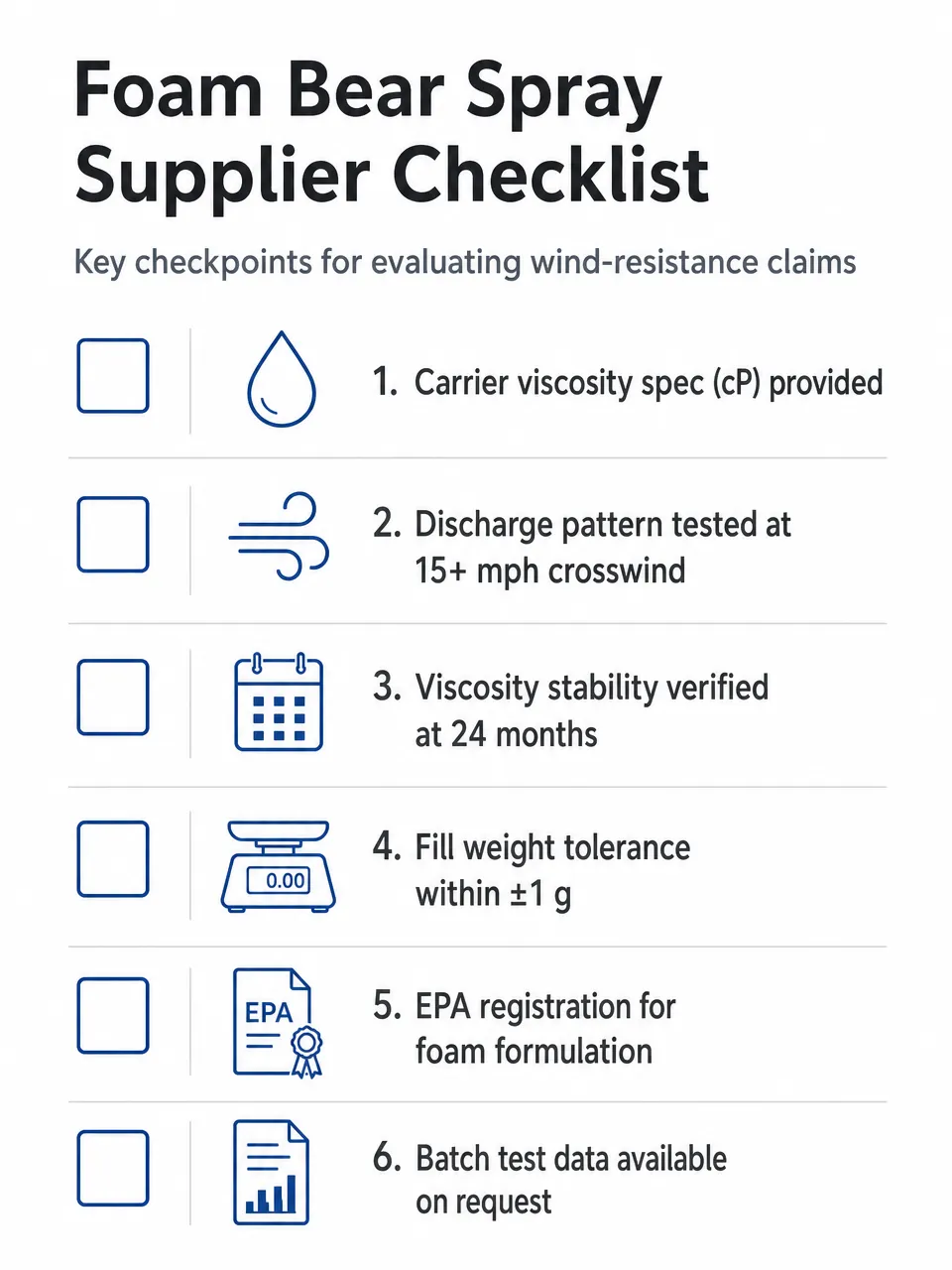
Sourcing checklist for evaluating foam bear spray wind resistance specifications from a supplier

Foam formulation customization for OEM buyers

If you're building a private-label foam SKU for a specific distribution channel, the formulation variables above aren't fixed — they're adjustable. Our R&D team handles custom foam formulation development for OEM buyers, and the scope of what can be adjusted is broader than most buyers expect.

Carrier viscosity can be tuned to a specific wind exposure target. If your end-user market is primarily alpine terrain with sustained winds above 20 mph, we can formulate toward the higher viscosity range to maximize foam cohesion. If you're targeting a mixed-terrain market where range matters as much as wind resistance, we can find a balance point that doesn't sacrifice too much of either.

CRC concentration is adjustable within the regulatory ceiling for your target market. For North American distribution, EPA registration requirements set the compliance parameters — we work within those. For European or Southeast Asian markets, the regulatory framework differs, and we can formulate to the applicable standard.

Canister size affects the propellant-to-formula ratio and therefore the discharge characteristics. A 225g canister and a 150g canister with the same formulation will behave differently in the field — the larger canister has more propellant headspace, which affects discharge pressure and foam particle formation. We account for this in the development process rather than treating it as a post-production variable.

Most custom foam formulation projects run 4-6 weeks from spec confirmation to approved sample. Buyers who come in with a clear terrain target, a regulatory market, and a canister size move through the process faster. The development work is handled internally — we don't subcontract formulation to a third-party lab, which means the iteration cycle is faster and the documentation stays in one place.

For buyers who want to understand the full range of Bear Spray Foam configurations we produce, the product page covers standard SKU options alongside OEM customization parameters.

Frequently asked questions

Does foam bear spray work in rain or high humidity?

Foam formulations are generally less affected by rain than aerosol mist patterns, because the larger particles don't disperse as readily. High humidity can affect carrier viscosity over time if the formulation isn't stabilized for the storage environment — this is a shelf-life consideration rather than a deployment consideration. For buyers distributing to coastal or high-humidity markets, confirm viscosity stability data at elevated humidity with your supplier before committing to a SKU.

What wind speed is too high for any bear spray pattern?

At sustained winds above 25-30 mph, all spray patterns show significant performance degradation. Foam holds up better than cone or mist at these speeds, but it's not immune. At extreme wind speeds, the practical guidance for end-users is to position themselves upwind of the threat before deploying — which is a training and labeling issue, not a formulation issue. Buyers supplying markets with extreme wind exposure (coastal Alaska, exposed tundra) should include deployment guidance in their retail packaging.

Can I source foam and stream SKUs from the same manufacturer to cover both terrain types?

Yes, and this is a common approach for distributors covering multiple market segments. Running both SKUs from the same manufacturer simplifies your documentation, your import process, and your reorder logistics. We produce both foam and stream configurations across our product range — the formulation and valve engineering are different, but the production standards, QC process, and documentation are consistent across both.

What MOQ applies to custom foam formulations?

Standard foam SKUs are available at lower MOQs. Custom formulation work — where we're adjusting carrier viscosity, CRC concentration, or canister format to your spec — typically requires a minimum run that justifies the development and line setup cost. The specific MOQ depends on canister size and formulation complexity. The right starting point is to send us your terrain target, regulatory market, and volume expectations, and we'll give you a realistic MOQ and development timeline. Request a quote with those details and our team will respond with specifics.

How do I verify a supplier's foam wind resistance claims without field testing?

Ask for discharge pattern documentation at simulated wind speeds — a controlled fan test with documented methodology is the minimum acceptable evidence. Also ask for the carrier viscosity spec and the tolerance range. If a supplier can't provide viscosity data, the formulation isn't controlled tightly enough to guarantee consistent wind resistance. Third-party SGS test reports, where available, add another layer of verification. We make this documentation available to qualified buyers as part of the sourcing review process.

The Bear Spray category page covers our full product range, including standard and OEM foam configurations, with specification details for each SKU.
EPA-Registered Bear Spray: What the Label Requirements Mean for Importers and Distributors

An unregistered bear spray cannot legally be sold in the United States. That's not a technicality — it's the first thing you need to understand before you evaluate any supplier sample or accept any shipment destined for the US market.

We've been manufacturing bear spray for export to North America since 2010. In that time, we've seen buyers get caught with non-compliant stock, and the pattern is almost always the same: the supplier produced a functional product, but the label was wrong. Missing registration number. Incorrect active ingredient statement. No bilingual text where required. The canister works fine. It just can't be sold.

This article walks through what EPA registration actually means under FIFRA, which label elements you need to verify before you commit to an order, and what the compliance failure modes look like from a manufacturer's side.

Why Bear Spray Is a Pesticide Under US Law

Bear spray is regulated as a pesticide under the Federal Insecticide, Fungicide, and Rodenticide Act (FIFRA), administered by the EPA. The active ingredient — capsaicin and related capsaicinoids (CRC) — is classified as a biochemical pesticide. That classification puts bear spray squarely inside the EPA's registration framework, regardless of how it's marketed or what the end user calls it.

Under FIFRA Section 3, any pesticide sold or distributed in the United States must be registered with the EPA before it enters commerce. Registration is product-specific: it covers the formulation, the label, the use pattern, and the active ingredient concentration. A supplier who changes the CRC percentage, the carrier chemistry, or the label text without updating the registration is technically selling an unregistered product — even if the original registration is still active.

This matters for importers because the registration obligation doesn't disappear at the border. If you import unregistered bear spray, you are the party distributing an unregistered pesticide in US commerce. The EPA's enforcement authority under FIFRA extends to importers and distributors, not just manufacturers.

(The practical enforcement risk varies, but the liability doesn't. Retailers who discover non-compliant stock mid-season will push that liability back up the supply chain — and they'll have the paperwork to do it.)

The FIFRA Registration Framework: What It Covers and What It Doesn't

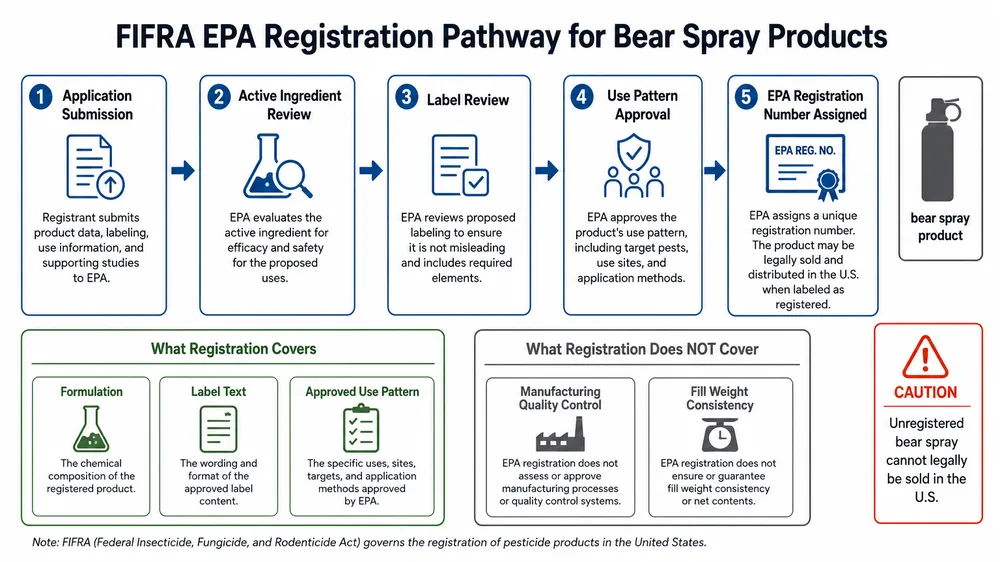
EPA registration under FIFRA is not a product safety certification in the conventional sense. It's a review and approval of the specific product as described in the registration application — formulation, label, use directions, and all.

When the EPA registers a bear spray product, it approves:

  • The active ingredient identity and concentration range
  • The inert ingredients (reviewed for safety, though not always publicly disclosed)
  • The label text, including use directions, first aid statements, signal word, and precautionary statements
  • The use pattern (bear deterrent, not general pest control)

What registration does not cover: manufacturing quality, fill weight consistency, or whether the product in the canister actually matches the registered formulation. That's a separate compliance question — and one that comes back to your supplier's QC process.

The registration number assigned to an approved product is a public record. You can verify any EPA registration number through the EPA's pesticide registration database. If a supplier gives you a registration number that doesn't match the product description in the database, that's a red flag worth stopping for.

Diagram showing the FIFRA EPA registration process for bear spray pesticide products, from application to label approval

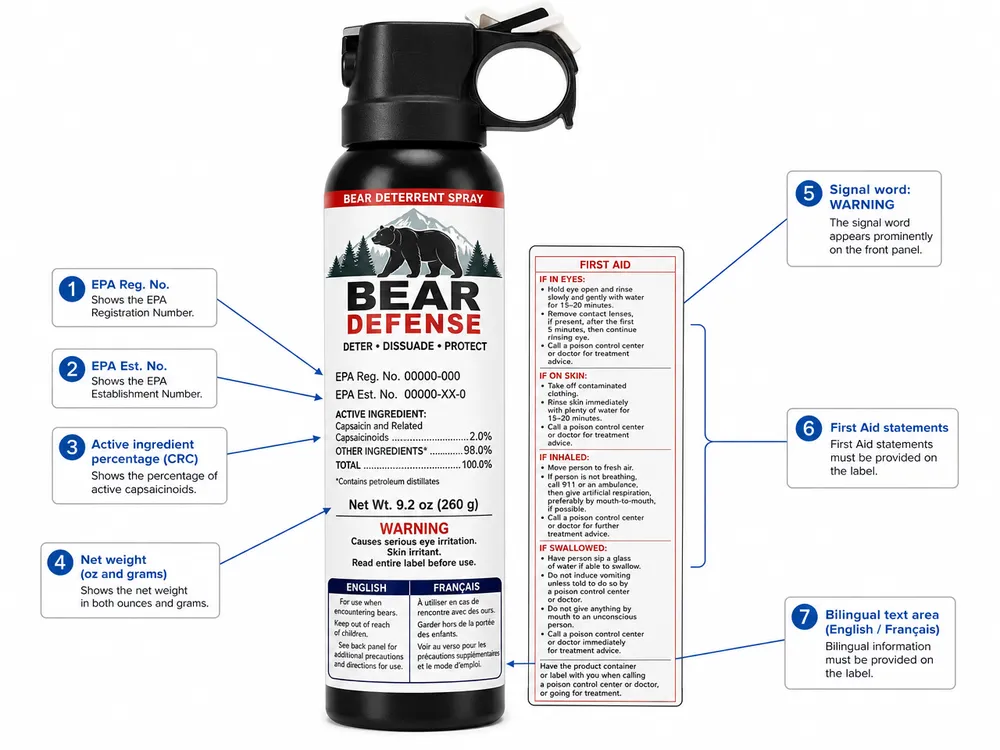
The Label Elements You Must Verify Before Accepting a Shipment

This is where most compliance failures happen. The product may be correctly formulated. The supplier may hold a valid EPA registration. But if the physical label on the canister doesn't match the registered label exactly, the product is non-compliant.

Here are the elements to check on every supplier sample before you place an order.

EPA Registration Number and Establishment Number

Every EPA-registered bear spray must display the EPA registration number in the format EPA Reg. No. XXXXX-XXXXX. This number identifies the specific registered product. The establishment number (EPA Est. No.) identifies the manufacturing facility where the product was produced.

Both numbers are required on the label. A label with only one, or with a number that doesn't match the EPA database, is non-compliant. We print both numbers directly into our label artwork at the design stage — not as a sticker or secondary print run — because any label that goes through our press without those numbers fails the pre-print check.

Active Ingredient Statement: CRC Percentage

The label must state the active ingredient as "Capsaicin and Related Capsaicinoids" with the percentage by weight. The EPA's registered concentration range for bear spray is 1.0% to 2.0% CRC. Products outside that range — either below 1.0% or above 2.0% — are not registered for use as bear deterrents under current EPA approvals.

The percentage on the label must match the registered formulation. If a supplier tells you their product is "2% CRC" but the label reads "1.0%," one of those numbers is wrong. Either the label is incorrect, or the supplier is misrepresenting the formulation. Either way, you need a Certificate of Analysis from an accredited lab before you accept the shipment.

We run HPLC testing on every incoming capsaicin batch and on finished product samples from each production run. The CoA we provide with each shipment reflects actual measured concentration, not the nominal spec. (Buyers who've dealt with suppliers who only provide nominal specs — without lab data — tend to appreciate the difference after the first time they get a non-compliant batch.)

Net Weight and Net Contents

The label must state the net weight of the product in both US customary and metric units. For bear spray, this is typically expressed in ounces and grams. The stated weight must match the actual fill weight within the tolerance specified in the registration.

Fill weight variance is one of the most common QC failures in aerosol manufacturing. A canister that's consistently 5% underfilled doesn't just fail the label claim — it may fall below the minimum net contents required for the registered use pattern. Our automated gravimetric filling system holds ±1g tolerance across a full production run, which keeps every canister within the labeled weight range.

Signal Word

Bear spray labels are required to carry a signal word — either CAUTION, WARNING, or DANGER — based on the acute toxicity profile of the formulation. Most bear spray products carry CAUTION or WARNING. The signal word must appear prominently on the front panel of the label.

A label missing the signal word, or with the wrong signal word for the registered formulation, is non-compliant. This is a straightforward check, but we've seen supplier samples where the signal word was present on the original label artwork but dropped during a label revision. Always check the physical sample, not just the artwork file.

First Aid and Precautionary Statements

The registered label includes specific first aid statements and precautionary language approved by the EPA. These cannot be modified, abbreviated, or omitted. If a supplier has shortened the first aid text to save label space, the label no longer matches the registered version.

This is an area where private-label buyers sometimes run into trouble. They want a cleaner label design, so they ask the supplier to trim the regulatory text. The supplier obliges. The result is a label that looks better but is no longer compliant with the registered version. We push back on those requests — not because we're inflexible, but because the label text is part of the registration, and changing it without an EPA amendment creates a compliance problem that lands on the importer.

Bilingual Requirements

For products sold in certain US markets — particularly California and other states with significant Spanish-speaking populations — bilingual labeling (English and Spanish) may be required by state law or by retailer specification. Some major outdoor retail chains require bilingual labels as a standard listing condition.

The EPA registration itself may or may not require bilingual text, but your downstream retail requirements often do. We include bilingual label text as standard on our North America export packaging, because the cost of adding it at the label printing stage is negligible compared to the cost of a retailer rejection or a relabeling project after the container arrives.

Annotated bear spray label showing required EPA registration elements including registration number, CRC percentage, signal word, and first aid statements

Label Verification Checklist for Importers

Before accepting a supplier sample for a US-market order, run through this checklist:

Label Element What to Check Where to Verify
EPA Reg. No. Present, format EPA Reg. No. XXXXX-XXXXX EPA pesticide database
EPA Est. No. Present, matches manufacturing facility EPA establishment database
Active ingredient "Capsaicin and Related Capsaicinoids," 1.0%–2.0% CRC Matches CoA from accredited lab
Net weight Stated in oz and grams, matches fill spec Weigh sample canisters
Signal word CAUTION, WARNING, or DANGER — present on front panel Physical label check
First aid statements Complete, unabbreviated, matches registered text Compare to EPA-registered label
Use directions "Bear deterrent" use pattern, not general pest control Physical label check
Bilingual text English/Spanish if required by retailer or state Confirm with your retail accounts
UPC Present and scannable if required for retail Scan test

Request the EPA registration number from your supplier before you order samples. Look it up in the EPA database and confirm the registered label matches what's on the physical canister. If the supplier can't provide the registration number, or if the number doesn't match the product description in the database, stop there.

What Happens When the Label Is Wrong

The consequences of non-compliant labeling are not theoretical. They play out in specific, costly ways.

Import refusal at the port of entry. US Customs and Border Protection works with the EPA to screen pesticide imports. A shipment of bear spray without a valid EPA registration number on the label can be refused entry. You're looking at storage costs, potential destruction of the shipment, and the loss of the product cost — with no recourse against the supplier unless your purchase contract specifically addresses compliance liability.

Retailer delisting. Major outdoor retailers — REI, Bass Pro, Cabela's, and similar accounts — run compliance checks on pesticide products. A non-compliant label discovered during a retailer audit can result in immediate delisting and a chargeback for the cost of pulling the product from shelves. We've heard from buyers who've been through this. It's an expensive lesson.

Recall liability. If non-compliant product reaches consumers and the EPA initiates a recall or stop-sale order, the importer and distributor are in the enforcement chain. FIFRA civil penalties for distributing unregistered pesticides can reach $5,000 per violation per day for commercial entities. The EPA's enforcement history on pesticide labeling is real — it's not a risk that only applies to large companies.

Downstream warranty and return exposure. Even without formal enforcement action, a retailer who discovers non-compliant stock mid-season will return it. Your return authorization process, your freight costs, and your margin on that order are all at risk.

The common thread in all of these scenarios: the importer bears the cost, not the supplier. Your purchase contract can shift some of that risk back to the supplier, but only if you've documented the compliance requirements in the order spec and the supplier has explicitly warranted compliance. Most standard purchase orders don't include that language.

How to Request and Verify EPA Registration Documentation from a Supplier

When you're evaluating a new supplier for US-market bear spray, the documentation request should happen before you discuss pricing or MOQ. Here's what to ask for:

1. EPA registration number. Ask for the full registration number in EPA Reg. No. XXXXX-XXXXX format. Look it up in the EPA's pesticide product label system (PPLS) at the EPA website. Confirm the registrant name, the active ingredient, and the registered concentration match what the supplier is offering.

2. Copy of the registered label. The EPA maintains copies of registered labels in the PPLS database. Compare the registered label to the physical label on the supplier's sample. They should match exactly. Any differences — even minor formatting changes — indicate the label has been modified without an EPA amendment.

3. Certificate of Analysis for active ingredient. Request a CoA from an accredited third-party laboratory showing the CRC concentration of the specific batch you're evaluating. The CoA should reference the batch number and the test method (HPLC is standard). A supplier who can only provide a nominal spec without lab data is a supplier whose QC process you can't verify.

4. EPA establishment number. Confirm the establishment number on the label matches the facility where the product was manufactured. If the supplier uses a contract manufacturer, the establishment number should reflect the actual production facility, not the registrant's office address.

5. SGS or third-party audit report. For buyers who need additional documentation for their import process, a third-party audit report from SGS or a similar body provides independent verification of the manufacturing facility's quality system. We make our SGS audit reports available on request — it's part of the standard documentation package for North America export orders.

For buyers sourcing bear spray for the first time, or switching suppliers after a compliance issue, this documentation review is the right place to start. It takes less time than a failed import clearance.

How Label Compliance Works at the Production Stage

There's a difference between a supplier who treats EPA label compliance as a documentation exercise and one who builds it into the production process. From where I sit on the production floor, the difference shows up in how label errors get caught — or don't.

At SOHAPI, label compliance is part of the pre-production checklist, not a post-production review. Before any label goes to print, our compliance team compares the artwork against the registered label text element by element: registration number, establishment number, active ingredient statement, signal word, first aid text, net weight, and bilingual requirements. The artwork doesn't go to the press until that check is signed off.

During production, the post-label inspection checkpoint includes a visual check and a barcode scan on every canister. If a label is misaligned, missing text, or has a barcode that doesn't scan, it gets pulled before it reaches the packaging stage. We don't rely on end-of-line sampling for label compliance — by the time you're sampling at the end of the line, you've already produced a lot of non-compliant units.

For private-label buyers, we provide a label proof with the EPA registration text pre-populated before we finalize the artwork. The buyer reviews the design; we confirm the regulatory text is complete and correct. That review happens before the label film is made, not after the first production run. (We've had buyers come to us after a previous supplier produced 10,000 units with a label error that wasn't caught until the retailer's compliance team flagged it. The relabeling cost was significant. The relationship cost was worse.)

Our export packaging for North America includes EPA registration text, bilingual English/Spanish requirements, and UPC as standard — not as add-ons that require a separate specification. The goal is that your containers arrive shelf-ready, with the compliance documentation already in the shipment file.

You can review our bear spray certifications for the full documentation set we provide with North America export orders, including ISO 9001:2015, CE, and SGS audit reports.

Frequently Asked Questions

Can I sell bear spray in the US if it's manufactured overseas?

Yes, but the product must be registered with the EPA under FIFRA before it enters US commerce. The registration can be held by the foreign manufacturer, a US importer of record, or a US distributor — but someone in the supply chain must hold a valid EPA registration for the specific product. If you're importing under a supplier's existing registration, confirm that the registration covers the exact formulation and label you're importing. A registration held by the manufacturer does not automatically cover a private-label version with a different label.

What's the difference between the EPA registration number and the establishment number?

The registration number (EPA Reg. No.) identifies the specific registered product — the formulation and label approved by the EPA. The establishment number (EPA Est. No.) identifies the physical facility where the product was manufactured. Both are required on the label. A product manufactured at a different facility than the one listed in the establishment number is technically non-compliant, even if the registration is valid.

Does the EPA registration cover the entire concentration range, or a specific percentage?

EPA registrations for bear spray typically cover a concentration range (1.0%–2.0% CRC) rather than a single fixed percentage. The label must state the actual concentration of the specific product, and that concentration must fall within the registered range. A product labeled at 1.5% CRC must actually contain 1.5% CRC — not 1.2%, not 1.8%. The CoA from your supplier should confirm the measured concentration matches the label claim.

What happens if I receive a shipment and discover the label is non-compliant after it's already in my warehouse?

Stop distribution immediately. Distributing a non-compliant pesticide after you're aware of the issue increases your enforcement exposure. Contact the supplier to document the non-compliance and your stop-distribution decision. Depending on the nature of the error, you may be able to relabel the product if the formulation itself is compliant and you can obtain an amended label from the registrant. Consult with a regulatory attorney before making any distribution decisions on stock you believe may be non-compliant.

Does SOHAPI hold its own EPA registration, or does the buyer need to arrange registration?

This depends on the order type. For standard SKUs we supply to North America buyers, the EPA registration is in place and the label is compliant. For private-label orders where the buyer wants their own brand name and label design, the registration situation depends on whether the buyer wants to hold the registration themselves or source under an existing registration. We work through this with buyers during the pre-order consultation — it's a question worth resolving before you finalize the label design, not after. Contact us to discuss your specific situation.

How do I verify a supplier's EPA registration number before placing an order?

The EPA maintains a public database of registered pesticide products called the Pesticide Product Label System (PPLS). You can search by registration number, registrant name, or active ingredient. The database shows the registered label, the registrant, the active ingredient, and the registration status. If a supplier gives you a registration number that returns no results, or returns a different product than what you're being offered, that's a compliance problem you need to resolve before the order is placed.

Sourcing Decisions That Reduce Compliance Risk

EPA label compliance is not a one-time check. It's a sourcing decision that starts with supplier selection and runs through every order.

The suppliers who create the least compliance risk for importers are the ones who treat label compliance as a production process, not a documentation exercise. That means pre-print label review against the registered text, in-process label inspection during production, and a complete documentation package — registration number, CoA, SGS report — included with every shipment.

When you're evaluating suppliers for bear spray destined for the US market, the label compliance question is worth asking directly: "Show me your registered label and your pre-print review process." A supplier who can answer that question with specifics — not just "we're EPA registered" — is a supplier whose compliance process you can actually rely on.

For buyers who want to understand the formulation side of compliance — specifically how bear spray capsaicin concentration affects both efficacy and regulatory status — that's a separate but related question worth working through before you finalize your product spec.

If you have a specific US-market sourcing requirement and want to confirm EPA registration coverage before committing to an order, send us your target market, canister size, and any existing label spec. We'll confirm registration coverage and provide a sample label for review.

Bear Spray Capsaicin Concentration Explained: How to Read the Spec Sheet and Avoid Non-Compliant Stock

The most common sourcing mistake we see from first-time bear spray importers isn't choosing the wrong canister size or the wrong spray pattern. It's misreading the concentration figure on the spec sheet — and not realizing it until the product is already on a retail shelf or flagged at customs.

The confusion almost always comes down to one thing: total capsaicinoids vs. CRC. These are two different measurements, they produce two different numbers, and the EPA cares about only one of them. If your supplier quotes you a concentration figure without specifying which one, you don't actually know what you're buying.

This article walks through the distinction, how to read a bear spray CoA against EPA label requirements, and where in the supply chain non-compliant stock typically originates. We'll also explain how we control concentration at the formulation stage — because that's where the compliance risk is actually managed, not at the end of the line.

CRC vs total capsaicinoids: the number that determines compliance

Bear spray's active ingredient is capsaicin and related capsaicinoids — the compounds responsible for the irritant effect. But "capsaicinoids" is a family of compounds, not a single molecule. The group includes capsaicin, dihydrocapsaicin, nordihydrocapsaicin, homocapsaicin, homodihydrocapsaicin, and several minor analogs.

Total capsaicinoids is the sum of all of these. It's the broader measurement.

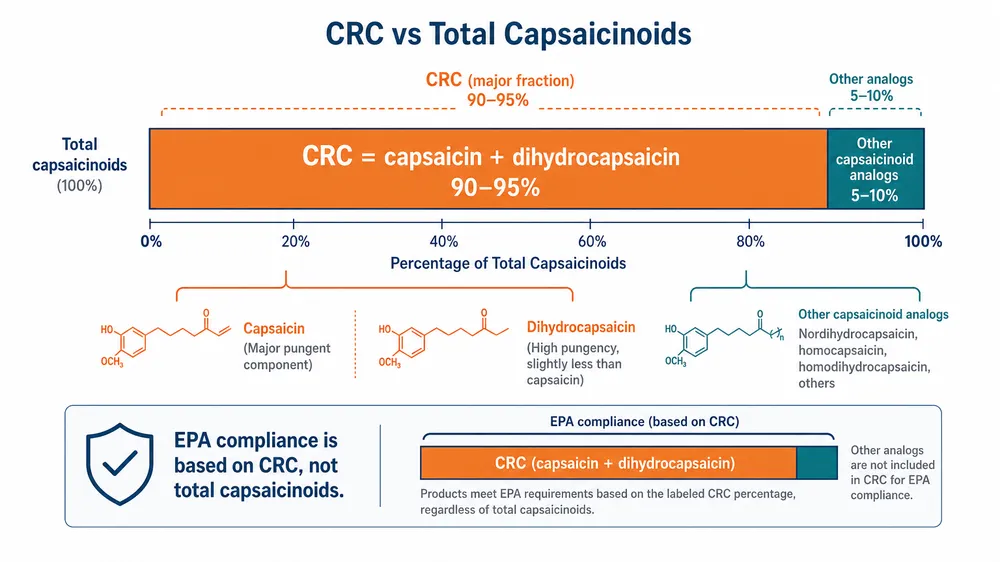
CRC (capsaicin-related compounds) is a narrower subset — typically capsaicin and dihydrocapsaicin, which together account for roughly 90–95% of the biological activity in a well-formulated product. The EPA's bear spray registration requirements are written around CRC, not total capsaicinoids.

The EPA requires a minimum of 1.0% CRC by weight for a product to qualify as a bear deterrent under FIFRA registration. The practical ceiling most US-market products target is 2.0% CRC, which is where the major retail brands sit. Products above 2% CRC exist but require separate registration review.

Here's where the confusion enters: a supplier quoting "2% capsaicinoids" may be reporting total capsaicinoids, not CRC. Depending on the raw material source and extraction method, total capsaicinoids can run 10–20% higher than the CRC fraction. A product with 2.0% total capsaicinoids might have only 1.7–1.8% CRC — which still clears the 1% floor but would be mislabeled if the label claims 2% CRC.

(We've seen this exact scenario in incoming samples from buyers who were switching suppliers. The previous supplier's CoA said "2% capsaicin" — no further specification. The HPLC result came back at 1.72% CRC. Technically compliant, but not what the label said.)

Diagram comparing total capsaicinoids vs CRC fraction in bear spray formulation with labeled compound breakdown
Figure 1. CRC (capsaicin + dihydrocapsaicin) typically represents 90–95% of total capsaicinoids in a well-formulated bear spray. The EPA's minimum concentration requirement is expressed in CRC, not total capsaicinoids — a distinction that directly affects label compliance.

What the EPA actually requires on the label

The EPA's bear repellent registration framework (under FIFRA) sets the following minimum requirements for a product to be labeled and sold as a bear deterrent in the US market:

Requirement Minimum / Specification
Active ingredient Capsaicin and related capsaicinoids (CRC)
Minimum CRC concentration 1.0% by weight
Minimum net weight 7.9 oz (225 g)
Minimum spray duration 6 seconds continuous discharge
Minimum effective range 25 feet (7.6 m)
Label language Must state EPA registration number, active ingredient %, net weight, and directions for use

The label must state the CRC percentage — not total capsaicinoids, not "capsaicin content," not a generic "active ingredient" figure. If your product's label says "2.0% Capsaicin and Related Capsaicinoids" and the CoA shows 1.85% CRC, you have a labeling violation.

For Canadian buyers, Health Canada's PMRA has its own registration pathway. The concentration requirements are similar in structure but the registration documentation differs. European markets generally don't have a bear spray-specific regulatory framework, but products sold as deterrents still need to meet the concentration claims on the label under general consumer product law.

If you're sourcing for multiple markets, the US EPA requirement is the most specific and the most commonly audited — it's the right baseline to build your spec around. See our article on EPA-registered bear spray for a full breakdown of the registration documentation requirements.

How to read a bear spray CoA: the fields that matter

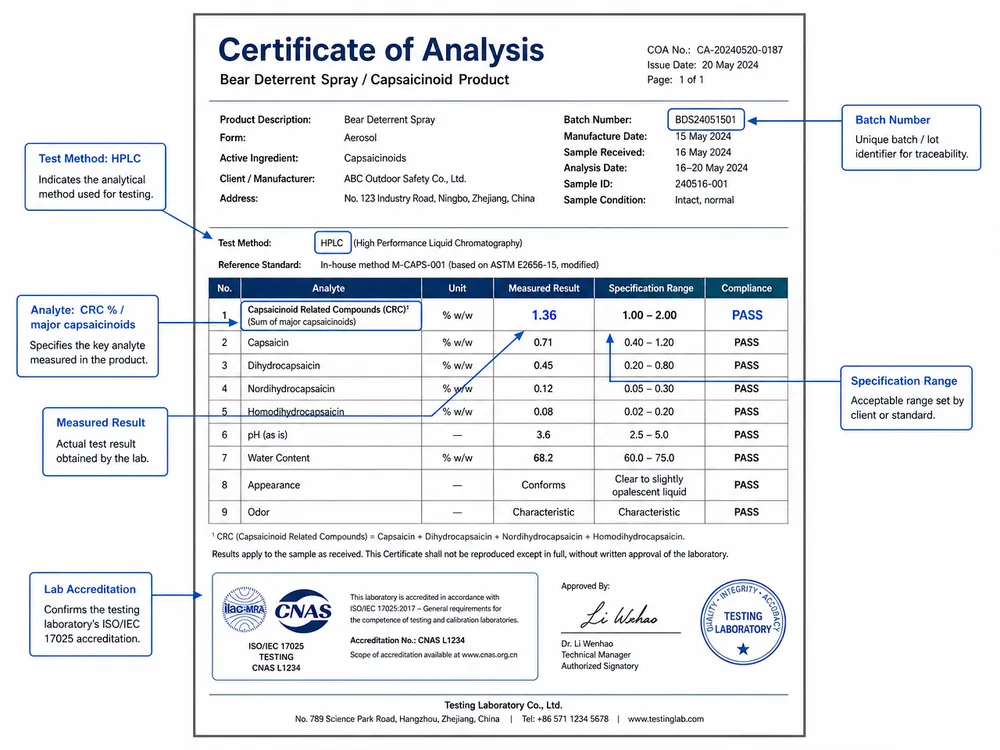
A Certificate of Analysis from a bear spray manufacturer should contain at minimum:

  • Product name and batch/lot number
  • Test method — HPLC is the standard for capsaicin quantification; UV spectrophotometry is less precise and more prone to interference from carrier compounds
  • Analyte reported — must specify CRC or individual compound names (capsaicin, dihydrocapsaicin), not just "capsaicinoids"
  • Result — expressed as % by weight
  • Specification range — the acceptable window (e.g., 1.8–2.2% CRC)
  • Pass/Fail determination
  • Testing laboratory — in-house or third-party, with accreditation noted
  • Date of analysis

The fields that most commonly mislead buyers:

"Capsaicin content" without method specification. This could be HPLC-measured CRC, total capsaicinoids by UV, or an estimate from the raw material supplier's certificate. Ask which.

Spec range stated as a single number. A CoA that says "2.0% capsaicin" with no range is reporting a nominal target, not a verified batch result. A real batch result has a measured value and a specification window.

Third-party lab name without accreditation. Any lab can issue a document that looks like a CoA. The ones that matter for import documentation are ISO/IEC 17025-accredited labs. SGS, Intertek, and Bureau Veritas are the names you'll see most often in international trade.

Annotated sample bear spray Certificate of Analysis showing key fields for CRC concentration, test method, and specification range
Figure 2. A compliant bear spray CoA should specify the test method (HPLC), the analyte (CRC or named compounds), a measured result with specification range, and the testing laboratory's accreditation. Missing any of these fields is a sourcing risk flag.

Where non-compliant stock originates

Non-compliant bear spray doesn't usually come from a manufacturer deliberately cutting concentration. It comes from process gaps that nobody caught — and the most common ones are predictable.

Batch variance in the raw material. Capsaicin concentrate is an agricultural extract. The CRC fraction varies between batches depending on the pepper source, extraction method, and storage conditions. A supplier who doesn't test incoming concentrate — or tests only the first batch from a new supplier — is running on the assumption that every batch matches the spec. That assumption fails regularly.

Concentration drift during formulation. The capsaicin concentrate is blended with a carrier (typically a petroleum-based or water-miscible solvent) and a propellant system. If the blend ratio drifts — because of a metering pump calibration issue, a temperature change affecting viscosity, or a manual addition error — the finished concentration moves with it. We control this at the formulation stage with in-process checks before the batch goes to the filling line. Catching it here costs an hour. Catching it after 10,000 units are filled costs a container.

Fill weight underage. Even if the formulation is correct, a canister that's 5% underfilled delivers 5% less active ingredient per discharge. At 1.0% CRC nominal, a 5% underfill puts the effective concentration below the EPA minimum. Our filling line runs automated gravimetric control to ±1g tolerance across the full production run — that's the spec we hold, and it's documented in the batch record.

Documentation gaps in the trading company layer. This is the one that's hardest to catch from the buyer's side. A trading company sourcing from multiple factories may consolidate CoAs, reformat documents, or pass through a supplier's nominal spec without verifying the actual batch result. The CoA looks complete. The product may not match it. Factory-direct sourcing eliminates this layer entirely — when you buy from us, the CoA comes from the same facility that made the product, and the batch number on the document matches the batch number on the carton.

How SOHAPI controls capsaicin concentration across the production run

We test capsaicin concentration via HPLC on every incoming batch of capsaicin concentrate — not spot checks, every batch. The HPLC method separates and quantifies capsaicin and dihydrocapsaicin individually, so the CRC figure we report is a measured result, not an estimate from the raw material supplier's certificate.

If an incoming batch falls outside our acceptance window, it doesn't enter the production floor. We've rejected batches from long-term suppliers when the numbers didn't hold. That's not a dramatic policy — it's just how you maintain a consistent finished product when your raw material has natural variance.

At the formulation stage, we run in-process concentration checks before the batch transfers to the filling line. The formulation team targets a specific CRC range — typically 1.9–2.1% for our standard US-market product — with enough headroom above the 1.0% EPA floor that normal production variance doesn't create a compliance risk. (Formulating right at 1.0% is a bad idea. Any downward variance puts you out of spec. We see this in samples from suppliers who are optimizing for raw material cost rather than compliance margin.)

The filling line runs automated gravimetric control. Each canister is weighed during fill, and the system flags and rejects any unit outside the ±1g tolerance window. Fill weight and concentration are the two variables that determine whether a finished canister meets the EPA's active ingredient requirement — we control both, and both are documented in the batch record.

For buyers who need third-party verification, SGS audit reports are available on request. For private-label orders targeting specific regulatory ceilings — US EPA, Canadian PMRA, or EU market requirements — our R&D team adjusts the formulation to hit the target range for your market. That's a standard part of our OEM process, not a special request.

You can review our full bear spray product range to see the standard configurations we ship, or reach out directly if you need a custom concentration spec.

Matching concentration spec to your target market before you order

The practical sourcing question isn't just "is this product compliant?" It's "compliant for which market, at what concentration, with what documentation?"

Here's how the major markets break down:

Market Regulatory body Minimum CRC Key documentation
United States EPA (FIFRA) 1.0% CRC EPA registration number on label, CoA with HPLC result
Canada Health Canada (PMRA) ~1.0% CRC (registration-specific) PMRA registration, bilingual label
European Union No bear spray-specific standard Label claim must be accurate CoA, safety data sheet, CE if applicable
Other markets Varies Varies Confirm with local import authority

For US retail, the practical target is 1.8–2.0% CRC. Products at 1.0–1.2% CRC are technically compliant but position poorly against established brands. Products above 2.0% CRC require additional EPA review and are harder to register quickly.

Before placing a bulk order, request the following from any supplier:

  1. HPLC CoA for the specific batch — not a generic product spec sheet
  2. Specification range, not just a nominal value — you want to see the acceptable window and the measured result
  3. EPA registration number — if the product is intended for US retail, this must exist before the product ships
  4. Fill weight tolerance documentation — ask what the gravimetric control spec is and how it's verified

If a supplier can't provide all four, the documentation gap is a sourcing risk. The product may be fine. You just can't verify it.

For a deeper look at how the bear spray repellent capsaicin spec translates into product performance differences at 1% vs 2% CRC, that article covers the efficacy side of the same question.

FAQ

What is the difference between CRC and total capsaicinoids in bear spray?

CRC (capsaicin-related compounds) refers specifically to capsaicin and dihydrocapsaicin — the two primary active compounds. Total capsaicinoids includes these plus several minor analogs. The EPA's bear spray registration requirement is written around CRC, so a supplier quoting total capsaicinoids is giving you a higher number that doesn't directly map to the regulatory standard. Always confirm which measurement a CoA is reporting.

What capsaicin concentration is required for EPA-compliant bear spray?

The EPA requires a minimum of 1.0% CRC by weight. Most US retail products target 1.8–2.0% CRC to provide compliance margin and competitive positioning. Products must also meet minimum net weight (7.9 oz / 225 g), spray duration (6 seconds), and effective range (25 feet) requirements — concentration alone doesn't determine compliance.

How do I verify a supplier's CoA is accurate before placing a bulk order?

Request the CoA for the specific batch you're ordering, not a generic product certificate. Confirm the test method is HPLC (not UV spectrophotometry), that the analyte is specified as CRC or named compounds, and that the testing lab is ISO/IEC 17025-accredited. For high-volume orders, third-party pre-shipment testing through SGS or Intertek is worth the cost — it's cheaper than a customs hold or a product recall.

Can batch variance in capsaicin concentrate cause a compliant product to become non-compliant?

Yes. Capsaicin concentrate is an agricultural extract with natural batch-to-batch variance. A manufacturer who doesn't test every incoming batch is relying on the raw material supplier's certificate, which reflects that supplier's average, not your specific batch. HPLC testing on every incoming batch — not spot checks — is the only way to catch variance before it enters production.

What documentation should I request before importing bear spray to the US?

At minimum: EPA registration number (must appear on the label), HPLC CoA for the production batch, fill weight tolerance documentation, and a safety data sheet. For private-label products, confirm the EPA registration covers your label format and concentration claim. If you're using a trading company, request documentation that traces back to the actual manufacturing facility, not just the trading company's letterhead.

What is the maximum CRC concentration allowed in US-market bear spray?

There's no hard ceiling in the EPA framework, but products above 2.0% CRC require additional registration review and are less common in retail. Most buyers targeting the US market spec at 1.8–2.0% CRC — it's the range where you're clearly above the compliance floor, competitive with established brands, and within the standard registration pathway. If you need a higher-concentration product, that's a formulation project that requires its own EPA review before it can be labeled and sold.

If you're ready to confirm a concentration spec for your target market, request a quote and include your target CRC range, canister format, and destination market — our formulation team will confirm feasibility and send back a detailed quote with CoA documentation.

Top 10 Bear Spray Suppliers in the USA: Pricing, MOQ, and Private-Label Options Compared for B2B Buyers

Most "top 10" lists for bear spray suppliers are retail brand roundups dressed up as sourcing guides. They tell you which canisters hikers prefer. They don't tell you who will actually sell you a pallet, what the MOQ floor is, whether the product carries an EPA registration number, or whether you can put your own label on it.

This article is built for a different reader — one who is shortlisting suppliers, comparing landed cost, and deciding whether a domestic distributor relationship or a factory-direct import program makes more sense for their volume and margin targets.

We'll cover the evaluation criteria that matter before you commit to a supplier, walk through 10 real companies operating in this space, and be direct about where local supply adds genuine value and where it compresses your margin without giving you anything in return.

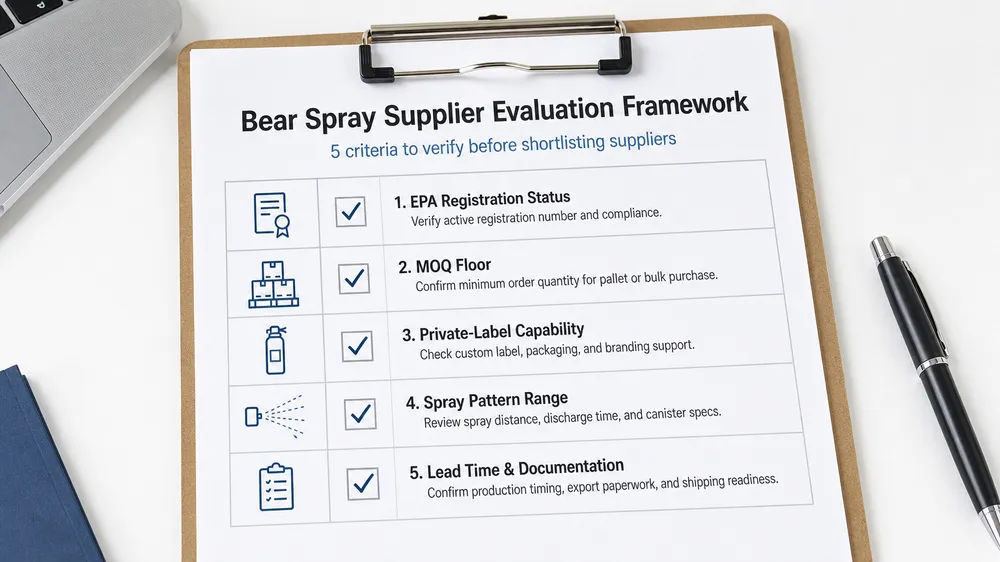
Supplier evaluation framework checklist for B2B bear spray buyers covering EPA status, MOQ, private-label capability, and lead time

Five Criteria That Separate Serious Suppliers from Catalog Listings

Before the list, the framework. These are the five questions worth asking every supplier you're considering — and the answers will sort the field faster than any ranking.

1. EPA Registration Status

Bear spray sold in the United States must be registered with the EPA as a pesticide under FIFRA. The registration number appears on the label. If a supplier can't provide an EPA registration number for the product you're buying, you cannot legally sell it in the US market. This sounds obvious, but it's the most commonly skipped verification step in the sourcing process — especially when buyers are sourcing from overseas or from distributors who don't manufacture the product themselves.

(We see this regularly: a buyer imports a container of product, the label looks right, but the EPA registration number belongs to a different formulation or a different registrant. That's a compliance problem that lands on the importer, not the factory.)

2. MOQ Floor and Tier Structure

The published MOQ is rarely the whole story. Some suppliers list a low MOQ to attract inquiries but price small orders at a unit cost that makes them unworkable. Others have a hard floor tied to their production line minimum — below that, they're pulling from existing stock, not running your spec. Ask specifically: is this MOQ for a production run, or for a stock order? The answer changes your lead time, your customization options, and your pricing.

3. Private-Label and OEM Capability

There's a meaningful difference between a supplier who will apply your label to their existing product and a supplier who can adjust the formulation, canister format, or spray pattern to your spec. The first is label printing. The second is actual OEM manufacturing. If you're building a branded product line, you need to know which one you're dealing with — and whether the supplier has in-house formulation capability or depends on a third-party lab for any changes.

4. Spray Pattern Range

Foam, stream, and cone patterns serve different market segments and carry different regulatory and performance profiles. A supplier who only offers one pattern limits your SKU flexibility. If your distribution channel spans outdoor retail, safety equipment, and institutional buyers, you'll want a supplier who can run multiple configurations — ideally from the same production infrastructure, so your quality baseline is consistent across SKUs.

5. Lead Time and Export Documentation

For domestic distributors, lead time is usually a stock question — they either have it or they don't. For manufacturers, lead time is a production scheduling question. The documentation piece matters most for import buyers: dangerous goods classification, SDS sheets, country-of-origin documentation, and any third-party audit reports your customs broker or retail buyer will require. Ask for the documentation package before you place an order, not after.

The 10 Bear Spray Suppliers Operating in This Market

The US bear spray market is smaller and more concentrated than most buyers expect. There are a handful of actual manufacturers, a larger number of distributors and resellers, and a growing segment of private-label brands sourcing from overseas factories. Understanding which category each supplier falls into is the most important piece of context for your sourcing decision.

1. UDAP Industries

Website: udap.com | Type: Manufacturer

UDAP (Universal Defense Alternative Products) is one of the original US bear spray manufacturers, based in Butte, Montana. They manufacture their own product and hold EPA registrations for their formulations. Their flagship product, the Pepper Power bear spray, has been on the market for decades and is well-recognized in the outdoor retail channel.

For B2B buyers, UDAP is a legitimate domestic manufacturer with real production history. Their product line is relatively narrow — focused on their core canister formats — and private-label capability is limited. MOQ for wholesale accounts typically starts in the hundreds of units, though exact tiers require direct inquiry. Lead times are generally shorter than overseas sourcing for standard SKUs, which is a genuine advantage for buyers managing seasonal inventory cycles.

Sourcing fit: Outdoor retailers and distributors who need a recognized domestic brand with reliable stock availability. Less suited for buyers who need custom formulations or private-label branding.

2. Counter Assault

Website: counterassault.com | Type: Manufacturer

Counter Assault, based in Kalispell, Montana, is another established US manufacturer with EPA-registered formulations. They produce a range of canister sizes and are known for their high-concentration formulations. Their products are distributed through outdoor specialty retailers, hunting and fishing channels, and some safety equipment distributors.

Counter Assault has a longer track record in the professional and guide market — their larger canister formats are commonly specified by wilderness guides and park services. For wholesale buyers, they offer tiered pricing, though the MOQ structure and private-label availability are not publicly disclosed and require direct negotiation. Their domestic manufacturing position means shorter lead times and no import documentation complexity.

Sourcing fit: Buyers serving professional outdoor, guide, and park service segments where Counter Assault's brand recognition carries value. Custom spec work is limited.

3. Frontiersman Bear Spray (SABRE)

Website: sabrered.com | Type: Manufacturer / Brand Owner

Frontiersman is the bear spray brand under SABRE (Security Equipment Corporation), one of the largest personal safety spray manufacturers in North America. SABRE manufactures their own formulations and holds EPA registrations. The Frontiersman line is widely distributed through mass retail, outdoor specialty, and online channels.

SABRE's scale gives them distribution reach that smaller manufacturers can't match. For wholesale buyers, they offer established retail programs with planogram support and marketing materials. Private-label capability exists within SABRE's broader business, but the Frontiersman brand itself is not typically available for white-label resale. MOQ for wholesale accounts is accessible, and their supply chain is well-organized for retail replenishment.

Sourcing fit: Distributors and retailers who want a nationally recognized brand with strong retail sell-through history. Not the right fit for buyers building their own branded product line.

4. Guard Alaska Bear Spray

Website: guardalaska.com | Type: Brand / Manufacturer

Guard Alaska is an EPA-registered bear spray brand with a specific claim: it is the only bear spray registered for use on all species of bears, according to their EPA registration documentation. This is a meaningful differentiator in markets where buyers are selling to customers in grizzly country, where the species-specific claim matters.

Guard Alaska is manufactured in the US and distributed through outdoor retail and safety channels. Their product line is focused — one primary formulation in a standard canister format. For wholesale buyers, they offer distributor pricing, but the product range is narrow and private-label options are not part of their standard offering.

Sourcing fit: Buyers who specifically need the "all-species" EPA registration claim for their market positioning. Limited SKU flexibility.

5. Mace Brand (Bear Spray Line)

Website: mace.com | Type: Brand / Distributor

Mace Brand is primarily known for personal defense sprays, but they carry a bear spray line as part of their broader personal safety product portfolio. Mace products are distributed through safety equipment channels, online retail, and some outdoor specialty accounts.

For B2B buyers, Mace offers the convenience of a single-vendor relationship if you're already sourcing personal defense products from them. Their bear spray line is EPA-registered. However, Mace is primarily a brand and distribution operation — they are not a dedicated bear spray manufacturer, which means customization and private-label options are limited, and production priority for bear spray specifically may not be their core focus.

Sourcing fit: Safety equipment distributors who want to consolidate personal defense and bear spray sourcing under one vendor. Not suited for buyers who need custom specs or high-volume dedicated production.

6. Halt! Animal Repellent (PetSafe / Radio Systems Corp)

Website: petsafe.net | Type: Brand / Manufacturer

Halt! is an animal repellent spray brand under Radio Systems Corporation (PetSafe). While primarily marketed as a dog repellent, Halt! products use capsaicin-based formulations and are EPA-registered. Some distributors carry Halt! alongside bear spray in their animal deterrent category.

This is a niche entry in the bear spray supplier landscape — Halt! is not a dedicated bear spray product, and the formulation and canister specs are different from standard bear deterrent products. For buyers specifically sourcing bear spray, Halt! is not a direct substitute. It's included here because it appears in distributor catalogs alongside bear spray and buyers sometimes encounter it during sourcing research.

Sourcing fit: Animal deterrent distributors who carry a broad repellent category. Not a bear spray replacement.

7. Udap Safety Products (Wholesale / Distribution Arm)

Website: udap.com | Type: Manufacturer with Wholesale Program

Beyond their direct retail presence, UDAP operates a wholesale program for distributors and outdoor retailers. Their wholesale pricing tiers are accessible for accounts meeting minimum order thresholds, and they offer drop-ship options for some retail partners.

The distinction here is operational: buying through UDAP's wholesale program versus their retail channel gives you different pricing, different lead time commitments, and access to their full SKU range including larger canister formats not always available at retail. For buyers who want a domestic manufacturer relationship with a structured wholesale program, UDAP's wholesale arm is worth a direct conversation.

Sourcing fit: Regional outdoor distributors and buying groups who want a domestic manufacturer relationship with structured wholesale terms.

8. Defense Technology (BAE Systems subsidiary)

Website: defense-technology.com | Type: Manufacturer (Institutional / Law Enforcement)

Defense Technology manufactures a range of less-lethal products including OC (oleoresin capsicum) sprays. Their product line is primarily oriented toward law enforcement and institutional buyers rather than outdoor retail. They hold EPA registrations for their OC formulations.

For bear spray specifically, Defense Technology is not a primary supplier — their canister formats and formulations are designed for law enforcement deployment, not wildlife deterrence. However, buyers sourcing for institutional or government accounts who need a single vendor for both personal defense OC and bear deterrent products may find them worth evaluating.

Sourcing fit: Institutional and government buyers with combined OC and bear deterrent requirements. Not suited for outdoor retail or private-label programs.

9. Yellowstone Bear World / Wilderness Safety Products (Distributor)

Website: Various regional distributors | Type: Distributor / Reseller

Regional distributors serving the Rocky Mountain and Pacific Northwest outdoor markets carry bear spray from multiple manufacturers — typically UDAP, Counter Assault, and Frontiersman — and offer consolidated ordering for accounts in their territory. These distributors provide genuine value for buyers who need mixed-brand orders, regional warehousing, and shorter replenishment cycles than direct manufacturer ordering allows.

The trade-off is margin: distributor pricing adds a layer between you and the manufacturer's cost. For small accounts or buyers who need emergency replenishment, that premium is worth paying. For buyers running consistent volume, the economics of going direct to a manufacturer — domestic or overseas — typically improve at the 500-unit-per-order threshold and above.

Sourcing fit: Small-to-mid accounts in bear country regions who need flexible replenishment and mixed-brand ordering. The distributor premium is the cost of that flexibility.

10. Sabre Red (Wholesale / OEM Division)

Website: sabrered.com | Type: Manufacturer with OEM Capability

SABRE's broader manufacturing operation — beyond the Frontiersman retail brand — includes OEM and private-label capability for qualified buyers. SABRE manufactures personal safety sprays at scale and has the formulation infrastructure to support custom concentration and canister format work for buyers who meet their volume thresholds.

For bear spray specifically, SABRE's OEM program is worth exploring if you need a US-manufactured private-label product and can meet their MOQ requirements, which are typically higher than overseas factory minimums. Their EPA registration infrastructure and domestic manufacturing position simplify the compliance side of a private-label program. The unit cost will be higher than factory-direct overseas sourcing, but the regulatory pathway is more straightforward.

Sourcing fit: Buyers who specifically need US-manufactured private-label bear spray and can meet higher MOQ thresholds. The domestic manufacturing premium is the cost of that compliance simplicity.

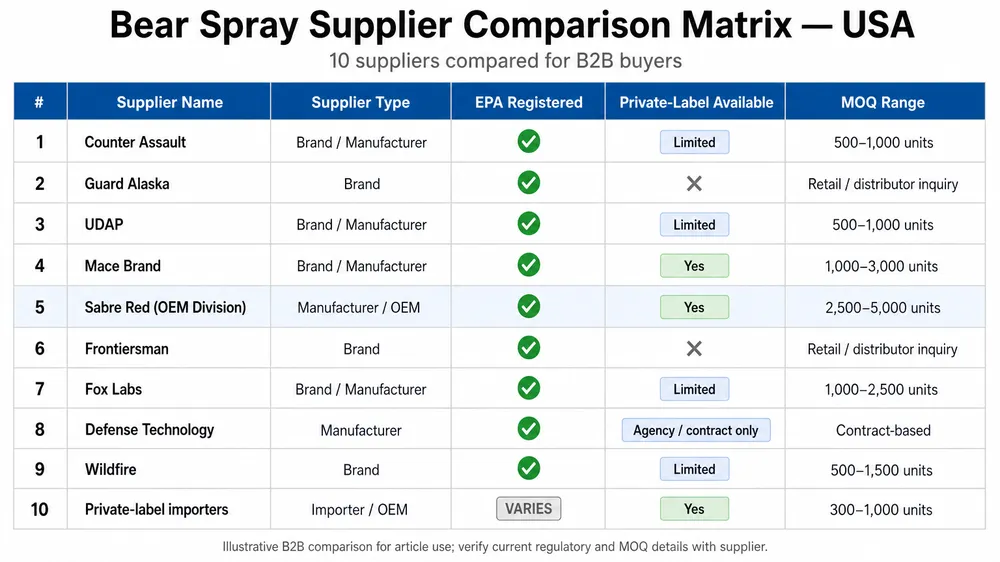
Comparison matrix of 10 bear spray suppliers in the USA showing MOQ range, private-label availability, EPA status, and spray pattern options

Supplier Comparison: MOQ, Private-Label, and EPA Status at a Glance

Supplier Type EPA Registered Private-Label MOQ Range
UDAP Industries Manufacturer Yes Limited ~100–500 units
Counter Assault Manufacturer Yes Limited ~100–500 units
Frontiersman (SABRE) Manufacturer / Brand Yes No (brand) Retail program
Guard Alaska Manufacturer / Brand Yes No ~100+ units
Mace Brand Brand / Distributor Yes No Distributor MOQ
Halt! (Radio Systems) Brand / Manufacturer Yes No Not bear spray
UDAP Wholesale Manufacturer Yes Limited ~200+ units
Defense Technology Manufacturer (LE) Yes No Institutional
Regional Distributors Distributor Via brand No Flexible
SABRE OEM Division Manufacturer Yes Yes High (US mfg)

The pattern in this table is worth noting: most US-based suppliers are either brand owners who don't offer private-label, or distributors who add a margin layer without adding manufacturing capability. The suppliers who do offer OEM or private-label work — primarily SABRE's OEM division — carry higher MOQ thresholds and unit costs that reflect domestic manufacturing economics.

Where Local Supply Adds Real Value

Local sourcing from US-based manufacturers and distributors has genuine advantages that are worth acknowledging before you run the cost comparison.

Replenishment speed. If you're managing a retail account with unpredictable sell-through — a regional outdoor chain, a park service gift shop, a hunting and fishing retailer — the ability to reorder 200 units and receive them in two weeks is worth something. No import lead time, no customs clearance, no container minimum.

Emergency stock. Seasonal demand spikes in bear country are real. If you're caught short in June and need product by July 4th weekend, a domestic distributor can solve that problem. A factory in Asia cannot.

Compliance familiarity. US manufacturers have already navigated EPA registration, FIFRA labeling requirements, and state-level restrictions. When you buy from a domestic manufacturer, you're buying a product that has already cleared those hurdles. The compliance risk sits with the manufacturer, not with you as the importer.

Relationship continuity. For buyers who value a phone call over an email thread, domestic suppliers offer communication in the same time zone, in the same language, with the same regulatory context. That has operational value, especially for buyers who are new to the category.

Where the Local Premium Compresses Your Margin

The honest trade-off: domestic manufacturing economics in the US mean higher unit costs than factory-direct overseas sourcing at equivalent volume. That premium is real, and it compounds across your supply chain.

A US-manufactured bear spray canister at wholesale typically runs in the range of $8–$14 per unit depending on size, formulation, and order volume. Factory-direct pricing from a dedicated overseas manufacturer at 1,000+ units runs materially lower — the gap widens as volume increases. At 5,000 units, the landed cost difference (including freight, duties, and documentation) can represent 30–50% of your unit cost, which translates directly into margin or competitive pricing room.

The private-label gap is even wider. US-based OEM programs for bear spray carry high MOQ thresholds — typically 2,000–5,000 units minimum for a custom label run — and unit costs that reflect domestic labor and overhead. Factory-direct OEM from a dedicated manufacturer can run custom formulations and private-label programs at lower MOQ thresholds and significantly lower unit costs, with the trade-off being longer lead times and the import documentation burden sitting on your side.

(The documentation burden is real but manageable. Dangerous goods classification, SDS sheets, and EPA registration verification are not complicated if your supplier provides a complete file. The buyers who struggle with import compliance are usually the ones who didn't ask for the documentation package before placing the order.)

The Distributor vs. Manufacturer Distinction — Why It Matters for Your Margin

Several entries in this list are distributors or brand owners, not manufacturers. That distinction has direct commercial implications.

A distributor buys from a manufacturer, marks up, and resells. You're paying for their inventory carrying cost, their warehousing, and their margin. For small orders and emergency replenishment, that's a fair trade. For repeat volume, you're paying a permanent premium for a service you may not need.

A manufacturer controls the production process, the formulation, and the cost structure. When you buy direct from a manufacturer — domestic or overseas — you're buying at a lower point in the supply chain. The savings are real, and they scale with volume.

The more important distinction for buyers considering private-label or OEM work: a distributor cannot customize the product. They can apply a label to an existing SKU, but they cannot adjust the capsaicin concentration, change the spray pattern, or modify the canister format. For that, you need a manufacturer with in-house formulation capability.

SOHAPI as a Factory-Direct Alternative for Custom-Spec and Volume Buyers

We've covered the US landscape honestly. Now the direct question: where does a factory-direct overseas manufacturer fit into this picture, and when does it make commercial sense?

SOHAPI is a dedicated bear spray manufacturer based in Japan, operating since 2010. We're not a general aerosol factory that added bear spray to the catalog — this is the only product category we build. 15,000 square meters, 8 production lines, 200 employees, 500,000 units annual capacity. ISO 9001:2015, CE, and SGS certified.

The "dedicated manufacturer" distinction matters more than it sounds. At a general aerosol factory, your bear spray order competes for production time with deodorant, insecticide, and industrial spray runs. Line changeovers introduce fill-weight drift. QC protocols are generalized, not calibrated to the specific failure modes of pressurized capsaicin canisters. We've seen the output from those facilities — it shows up in fill weight variance and valve crimp inconsistency that doesn't surface until the product is in your customer's hands.

Our filling line runs automated gravimetric control to ±1g tolerance across the full production run. Every crimped canister goes through a 100% water bath leak test — not statistical sampling, every unit. We run HPLC testing on every incoming capsaicin batch to verify concentration before it enters the production floor. These aren't marketing claims; they're the process steps that prevent the specific failure modes that generate returns and compliance problems in this product category.

For OEM & ODM bear spray manufacturing, our in-house R&D team handles formulation development directly — no third-party lab dependency. Custom capsaicin concentration, carrier viscosity adjustment for foam vs. stream vs. cone pattern, canister format changes — these are standard project types for us. Most custom formulation projects run 4–6 weeks from spec to approved sample. Trial orders run through the same production line and QC process as full production runs, so what you test is what you scale.

On the documentation side: ISO 9001:2015, CE, SGS audit reports, dangerous goods classification for DOT and IATA, SDS sheets, and country-of-origin documentation are all part of our standard export file. Your customs broker gets a complete package, not a back-and-forth for missing paperwork.

For buyers considering bear spray private label, the economics work differently than domestic OEM. Our MOQ for private-label programs is flexible — trial orders are available, and the unit cost at 1,000+ units is materially lower than US-manufactured equivalents. The trade-off is lead time (25–35 days for standard SKUs from order confirmation, longer for custom formulation projects) and the import documentation responsibility sitting on your side. For buyers running consistent volume on a planned procurement cycle, that trade-off is straightforward.

The buyers who get the most value from a factory-direct relationship are the ones who have moved past emergency replenishment mode — who are planning 90-day inventory cycles, building a branded product line, or sourcing for a distribution program where unit cost and margin control matter more than two-week replenishment windows.

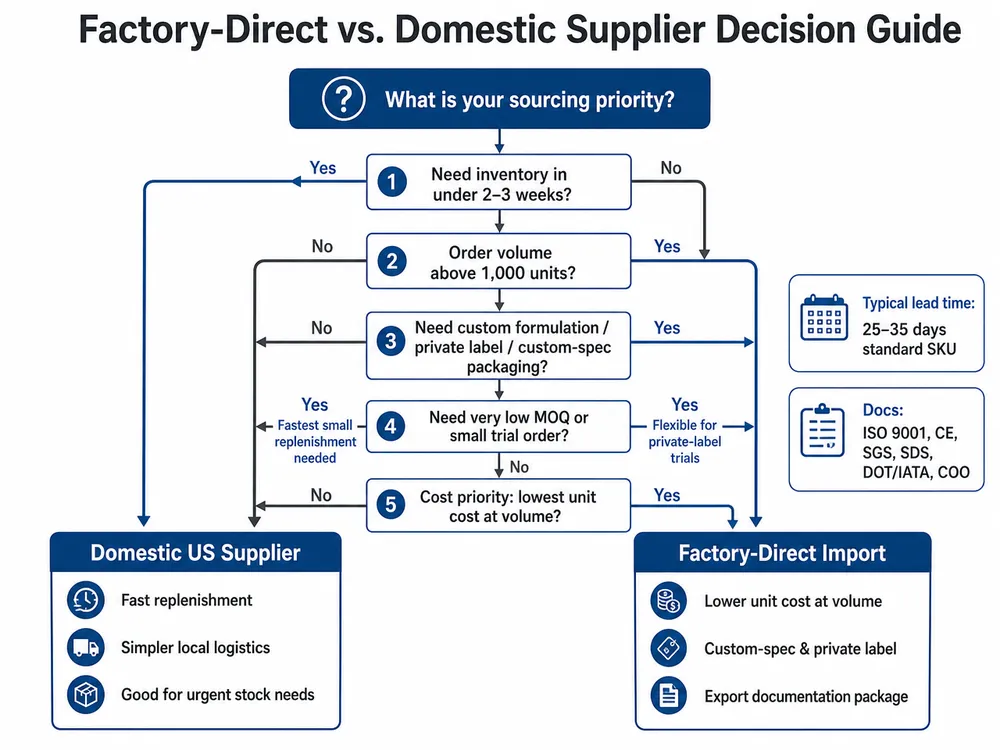
Decision flow diagram comparing factory-direct bear spray sourcing versus domestic US supplier sourcing based on order volume, lead time requirements, and private-label needs

Which Sourcing Route Fits Your Situation

The right answer depends on your order profile, not on a ranking.

Local domestic supplier is the right call when:

  • You need product in under 3 weeks
  • Your order volume is under 200 units per cycle
  • You're managing unpredictable seasonal demand with no forward planning window
  • You need a recognized US brand name for your retail channel
  • You're new to the category and want to minimize import compliance complexity

Factory-direct import makes commercial sense when:

  • You're running planned procurement cycles of 90 days or longer
  • Your per-order volume is 500 units or above
  • You need custom formulation, spray pattern, or canister format
  • You're building a private-label product line and need margin room to support your retail pricing
  • You want a supplier who can scale with your volume without production priority conflicts

The hybrid approach — domestic distributor for emergency replenishment, factory-direct for planned volume — is what most serious distributors in this category end up running. It's not either/or. The domestic relationship covers your short-cycle needs; the factory-direct relationship covers your cost structure on the volume that actually moves your margin.

How to Structure an RFQ for a Bear Spray Supplier

Whether you're approaching a domestic manufacturer or a factory-direct overseas supplier, the quality of your RFQ determines the quality of the response you get back. A vague inquiry gets a vague quote. A specific inquiry gets a price you can actually use.

Include these elements in your RFQ:

  • Canister size and fill weight target — 7.9 oz, 10.2 oz, or custom. Fill weight in grams.
  • Capsaicin concentration target — expressed as % CRC (capsaicinoids). EPA minimum for bear spray is 1.0% CRC; most US retail products run 1.0–2.0%.
  • Spray pattern — foam, stream, or cone. If you don't have a preference, say so and ask for the supplier's recommendation by channel.
  • Annual volume estimate — even a rough number (500 units/year vs. 5,000 units/year) changes the pricing tier and the conversation about MOQ.
  • Private-label requirement — yes or no. If yes, specify whether you need label-only or full formulation customization.
  • Target market — US retail, institutional, export. This affects EPA registration requirements and documentation needs.
  • Lead time requirement — your planning cycle and any hard delivery deadlines.

For EPA-registered bear spray specifically, ask the supplier to confirm the EPA registration number for the exact formulation you're buying — not a related product, the specific SKU. This is the single most important compliance verification step for US market entry.

Frequently Asked Questions

What is the minimum order quantity for bear spray wholesale in the USA?

It varies significantly by supplier type. Domestic distributors often have no hard MOQ — they'll sell you a case of 12. Domestic manufacturers typically start wholesale accounts at 100–500 units. Factory-direct overseas manufacturers run production-based MOQs that depend on their line minimums; for a dedicated bear spray manufacturer, trial orders in the 200–500 unit range are common, with full production runs starting at 1,000+ units. The key question is whether you're ordering from stock or triggering a production run — the answer changes your lead time and your customization options.

Does bear spray sold in the USA need to be EPA registered?

Yes. Bear spray is regulated as a pesticide under FIFRA (Federal Insecticide, Fungicide, and Rodenticide Act) and must carry an EPA registration number on the label. The registration covers the specific formulation — concentration, active ingredient, and intended use. Importing or selling bear spray without a valid EPA registration number is a federal violation. When sourcing from overseas, the importer of record is responsible for ensuring the product meets EPA registration requirements before it enters the US market. See our detailed guide on EPA-registered bear spray for the full verification checklist.

What capsaicin concentration should I specify when sourcing bear spray for US retail?

EPA requires a minimum of 1.0% CRC (capsaicinoids) for a product to be labeled as bear spray. Most US retail products run between 1.0% and 2.0% CRC. The practical ceiling is around 2.0% — above that, you're not adding meaningful deterrence performance, and you're increasing the regulatory scrutiny on the formulation. For most retail channels, 1.3–1.8% CRC is the standard range. If you're sourcing for a premium or "maximum strength" positioning, 2.0% CRC is the typical spec. Ask your supplier for HPLC test results on the specific batch you're buying — not a spec sheet claim, actual test data.

Can I source private-label bear spray from a US manufacturer?

Yes, but the options are limited and the MOQ thresholds are higher than overseas factory programs. SABRE's OEM division is the most accessible US-based option for private-label bear spray. Domestic private-label programs typically require 2,000–5,000 units minimum and carry unit costs that reflect US manufacturing economics. Factory-direct overseas OEM programs offer lower MOQ thresholds and lower unit costs, with the trade-off being longer lead times and import documentation responsibility. For buyers building a branded product line with planned volume, the overseas factory-direct route typically offers better margin economics. For buyers who specifically need US-manufactured product for their retail channel requirements, domestic OEM is the right path despite the higher cost.

What documentation do I need to import bear spray from overseas?

The core documentation package for importing bear spray into the US includes: EPA registration verification for the specific formulation, SDS (Safety Data Sheet) for the aerosol product, dangerous goods classification documentation (DOT for ground/ocean, IATA for air), certificate of origin, and the standard commercial invoice and packing list. Your customs broker will handle the import entry, but they need the complete documentation file from your supplier before the container ships. Suppliers who are experienced with US import will have this package ready — if a supplier can't produce it on request, that's a signal worth taking seriously. Our Bear Spray product pages include the certification and documentation details for SOHAPI's export program.

Bear Spray Stream Range and Discharge Rate: Specification Guide for Buyers Sourcing Long-Range Deterrents

Range is the first number buyers ask about when specifying a stream bear spray SKU. It's also the number most likely to mislead them. A supplier quotes "9 meters" on a spec sheet, the buyer locks in the order, and the product that arrives performs at 6 meters under real conditions. The gap isn't fraud — it's a measurement convention problem that most supplier spec sheets never explain.

This guide covers what bear spray stream range actually means as a documented spec, how discharge rate connects to it, what drives consistency across a production run, and what to ask a supplier before you commit to a stream configuration.

If you're comparing stream against other spray patterns first, the bear spray foam vs stream comparison covers that trade-off in detail.

Effective range vs. maximum range: the spec sheet distinction that matters

Most bear spray spec sheets list a single range figure. What they don't say is whether that number is maximum range or effective range — and the difference is significant when you're writing product claims for retail packaging or responding to a buyer's RFQ.

Maximum range is the distance the spray stream physically travels before it loses coherence and disperses. Under controlled lab conditions with no wind, a well-formulated stream canister can reach 9–10 meters. That's the number that tends to appear on spec sheets.

Effective range is the distance at which the spray delivers sufficient capsaicin concentration to function as a deterrent. In field conditions — light wind, ambient temperature variation, a user who isn't holding the canister at a perfect angle — effective range is typically 1–2 meters shorter than maximum range. For a canister rated at 9 meters maximum, effective range in real use is closer to 7–8 meters.

The EPA's minimum range requirement for registered bear spray is 7.62 meters (25 feet). That's a minimum effective range standard, not a maximum range claim. A product that hits 9 meters maximum but only 6 meters effective doesn't meet the threshold.

When you're reviewing a supplier's spec sheet, ask which measurement convention they're using. If they can't answer that question, the number on the sheet is probably maximum range measured under ideal lab conditions — and your retail packaging claims need to reflect effective range.

Diagram comparing maximum range and effective range of a bear spray stream pattern, showing the concentration drop-off zone

The four variables that determine stream range

A range number on a spec sheet is the output of four interacting variables. Understanding them tells you whether a supplier's claimed range is achievable across a full production run — or just a best-case sample result.

Propellant pressure drives the initial velocity of the spray stream. Higher pressure means longer reach, but it also affects discharge rate — more on that below. Propellant ratio (the percentage of propellant relative to the total fill weight) is set during formulation and must stay consistent across every canister in a batch. A batch where propellant ratio drifts by even 3–4% will show measurable range variance.

Valve orifice diameter controls how the pressurized contents exit the canister. A larger orifice increases discharge rate and can extend range, but it also reduces total spray duration for a given fill weight. Stream configurations use a narrower orifice than cone patterns — that's what gives the stream its directional coherence and longer reach. The orifice is set by the valve specification, and it doesn't change during production. What can change is valve-to-valve dimensional consistency, which is why valve sourcing and incoming inspection matter.

Carrier viscosity affects how the capsaicin solution behaves once it exits the valve. A lower-viscosity carrier produces a finer, faster-moving stream that travels farther before dispersing. A higher-viscosity carrier produces a heavier stream that drops sooner. We tune carrier viscosity during formulation development — it's one of the adjustments we make when an OEM buyer needs to hit a specific range target for a particular canister size.

Fill weight is the variable most buyers overlook. A canister that's 5% underfilled has less propellant driving the spray, which means lower pressure at the valve and shorter range — especially toward the end of the discharge. Fill weight tolerance across a production run directly affects range consistency. This is why our automated gravimetric fill control, which holds every canister to ±1g of target weight, isn't just a QC metric — it's what makes the range spec on your product label defensible across the full batch, not just the first few units off the line.

(We rebuilt our filling line around gravimetric control early on, after seeing fill weight drift cause range variance in a production run. The fix was infrastructure, not process tweaks.)

Discharge rate: what grams per second means for your sourcing decision

Discharge rate is the speed at which the canister contents are expelled, measured in grams per second (g/s). It's a spec that most buyers don't ask about — and it's one of the more commercially relevant numbers on a stream bear spray spec sheet.

Here's why it matters for sourcing:

A 225g canister with a discharge rate of 7.5 g/s delivers approximately 30 seconds of total spray time. The same canister with a discharge rate of 10 g/s delivers about 22 seconds. Both canisters have the same fill weight. Both can claim the same range. But the product with the higher discharge rate depletes faster, which affects how your downstream customers experience the product — and how you position it against competitors on shelf.

Discharge rate also interacts with range. Higher discharge rate generally supports longer range because more propellant is moving through the valve per second, maintaining pressure longer. But it comes at the cost of spray duration. The trade-off is a formulation decision, and it should be documented in the spec sheet you receive from your supplier.

The EPA doesn't specify a minimum discharge rate for bear spray, but it does require that the product deliver sufficient capsaicin concentration at the minimum effective range. A canister with a very low discharge rate may technically reach 7.62 meters but deliver insufficient concentration at that distance to meet the efficacy standard. This is a compliance risk that doesn't show up in a simple range test.

For buyers specifying MOQ across multiple canister sizes — say, a 150g travel SKU and a 325g full-size SKU — discharge rate is the variable that determines whether both products feel consistent to the end user. We typically tune discharge rate separately for each canister format rather than using a single valve spec across the range, because the pressure dynamics are different at different fill weights.

Chart showing the relationship between bear spray discharge rate in grams per second and total spray duration for 225g and 325g canisters

Spray pattern comparison: stream vs. cone vs. foam across range, discharge rate, and wind sensitivity

Stream is one of three primary spray pattern configurations in bear spray. The table below covers the key spec differences relevant to sourcing decisions.

Spec Stream Cone Foam
Typical effective range 7–9 m 5–7 m 4–6 m
Discharge rate Moderate–high (7–10 g/s typical) High (9–14 g/s typical) Low–moderate (5–8 g/s typical)
Wind sensitivity Low–moderate High Low
Spray duration (225g) 22–30 sec 15–22 sec 28–38 sec
Directional accuracy High Low Moderate
Blowback risk Low High Very low
Primary market fit Open terrain, long-distance encounters Dense brush, close encounters High-wind environments

Stream's range advantage over cone comes from the orifice geometry and carrier viscosity — the stream exits as a coherent jet rather than a dispersed cloud, so it maintains concentration over distance. The trade-off is that stream requires more accurate aim than cone, which matters for how you position the product in your distribution channel.

For a deeper comparison of stream and foam across wind resistance and blowback risk, see bear spray foam vs stream. For valve-level engineering detail on what controls stream pattern consistency, bear spray stream valve engineering covers that specifically.

How production consistency determines whether your range spec holds across a batch

A supplier can produce a sample canister that hits 9 meters. The question is whether unit 4,800 in your order performs the same as unit 1.

Three production variables determine batch-level range consistency:

Fill weight tolerance. We've covered this above, but it's worth being direct: ±1g gravimetric fill control is the standard we hold on every line, every run. Most aerosol manufacturers work to ±3–5g tolerances. At ±5g on a 225g canister, you have a 2.2% fill weight variance — enough to produce measurable range differences between units at the low end of the tolerance band. If a supplier can't tell you their fill weight tolerance, assume it's wider than you'd want.

Valve crimping consistency. The crimp seal between the valve and the canister body determines the internal pressure the canister maintains over its shelf life. An under-crimped valve leaks slowly — the canister that's been sitting in a warehouse for 18 months has lower pressure than the one that shipped last week, and lower pressure means shorter range. We use automated crimping equipment calibrated to the valve manufacturer's torque specifications, and every crimped canister goes through a water bath leak test before it moves to labeling. That's not a statistical sample — it's 100% of units.

Propellant ratio control. Propellant is blended into the formulation at the filling stage. If the propellant ratio drifts during a long production run — which happens when filling equipment isn't properly calibrated or when the propellant supply pressure varies — the canisters filled at the start of the run will have different range characteristics than those filled at the end. We run propellant ratio checks at the start of each shift and after any line interruption. It's a 10-minute check that prevents a container of out-of-spec product.

The practical implication for buyers: when you're evaluating a supplier's range claim, ask for discharge rate data from final outgoing inspection, not just a sample test result. A supplier who runs discharge rate measurement at final inspection has production-level data. A supplier who only tests samples has sample-level data — and those are different things.

Regulatory context: EPA range requirements in sourcing language

The EPA registers bear spray as a pesticide under FIFRA (Federal Insecticide, Fungicide, and Rodenticide Act). For a product to be sold as bear spray in the US market, it must meet minimum performance standards, including a minimum spray range of 7.62 meters (25 feet).

That 7.62-meter figure is an effective range requirement — the product must deliver deterrent-level capsaicin concentration at that distance, not just physically reach it. This distinction matters when you're reviewing a supplier's EPA registration documentation or writing product claims for US retail packaging.

A few sourcing implications:

  • If a supplier's spec sheet lists range as "7.5 meters," that product may not meet the EPA minimum under real-use conditions. The margin is too thin. Specify a minimum effective range of 8 meters or above to give yourself compliance headroom.
  • EPA registration is product-specific, not factory-wide. A factory can be ISO 9001 certified and still supply you with a formulation that isn't EPA-registered. Verify the registration number for the specific SKU you're ordering, not just the factory's general credentials.
  • Private-label buyers who modify the formulation — changing capsaicin concentration, carrier chemistry, or propellant ratio — may need to re-register the product with the EPA. This is a common oversight in OEM sourcing that adds months to a product launch timeline.

(We've walked buyers through this process more than once. The EPA registration path for a modified formulation isn't complicated, but it has a timeline, and it needs to start before you finalize the product spec — not after.)

What to ask a supplier about stream range specs before you commit

Most sourcing conversations about bear spray stream range focus on the peak number. These are the questions that actually tell you whether the spec is real and repeatable:

1. Is the range figure on your spec sheet maximum range or effective range? If they can't distinguish between the two, the number is probably maximum range under ideal conditions.

2. What is your fill weight tolerance across a production run? ±1g is tight. ±5g is loose. Anything wider than ±3g on a 225g canister will produce range variance you'll see in field returns.

3. What is the discharge rate for this SKU, and how is it measured? Ask for grams per second, not a qualitative description. Ask whether it's measured at the start of discharge, mid-discharge, or as an average — these give different numbers.

4. Do you run discharge rate measurement at final outgoing inspection? This tells you whether the supplier has production-level data or only sample-level data.

5. What valve specification are you using, and who is the valve supplier? Valve orifice diameter is the primary determinant of discharge rate and stream pattern. A supplier who can answer this question has control over their supply chain. One who can't is probably assembling from whatever valve stock is available.

6. Can you provide batch records or QC data from a recent production run? A supplier with a real QC system can pull this. It doesn't need to be a full MTC — a discharge rate log and fill weight log from a recent batch is sufficient to verify that the production process is controlled.

7. What is the EPA registration number for this specific formulation? Not the factory's general certifications — the registration number for the SKU you're buying.

These questions separate suppliers who have documented production control from those who have a good sample and a confident sales team. The answers also tell you whether the range spec on your product label is defensible if a downstream customer or regulator asks for it.

For buyers ready to specify a stream SKU with documented range and discharge rate performance, the Bear Spray Stream product page covers our standard configurations. If you need a custom range target or a specific discharge rate for a private-label project, send us an RFQ with your canister size, target market, and range requirement — we'll provide a spec sheet and sample for evaluation.

Frequently asked questions

How far does bear spray stream reach in meters? A well-formulated stream bear spray reaches 7–9 meters effective range under typical field conditions. Maximum range under controlled lab conditions can reach 9–10 meters. The EPA minimum for registered bear spray is 7.62 meters effective range. When reviewing supplier specs, confirm which measurement convention the range figure represents.

What discharge rate should I specify for a long-range stream bear spray? For a 225g canister targeting 8+ meters effective range, a discharge rate of 7.5–9 g/s is a reasonable target. Higher discharge rates (10+ g/s) can extend range but reduce total spray duration. The right number depends on your canister size and how you're positioning the product — a longer-duration product and a longer-range product are different formulation decisions.

Does fill weight tolerance affect bear spray stream range? Yes, directly. A canister at the low end of a wide fill weight tolerance band has less propellant, lower internal pressure, and shorter range — particularly toward the end of the discharge. Specify fill weight tolerance in your RFQ and ask for gravimetric fill control documentation. ±1g tolerance is achievable with automated gravimetric equipment; ±5g is a sign of manual or poorly calibrated filling.

What is the EPA minimum range requirement for bear spray? 7.62 meters (25 feet) effective range. This is a minimum, not a target. Products that barely clear this threshold have no compliance margin for production variance or real-use conditions. Specify 8 meters or above as your sourcing minimum.

Can a supplier tune discharge rate for a specific canister size? Yes, through valve orifice selection and propellant ratio adjustment. A supplier with in-house R&D capability can hit a specific discharge rate target for a given canister format. This matters when you're specifying multiple SKUs and want consistent performance characteristics across your product line.

What documents should I request to verify stream range performance? At minimum: a spec sheet with effective range and discharge rate clearly stated, fill weight tolerance documentation, and discharge rate data from final outgoing inspection. For US market products, the EPA registration number for the specific formulation. SGS audit reports are available from us on request for buyers who need third-party documentation for import clearance.