
Most "top 10" lists for bear spray suppliers are retail brand roundups dressed up as sourcing guides. They tell you which canisters hikers prefer. They don't tell you who will actually sell you a pallet, what the MOQ floor is, whether the product carries an EPA registration number, or whether you can put your own label on it.
This article is built for a different reader — one who is shortlisting suppliers, comparing landed cost, and deciding whether a domestic distributor relationship or a factory-direct import program makes more sense for their volume and margin targets.
We'll cover the evaluation criteria that matter before you commit to a supplier, walk through 10 real companies operating in this space, and be direct about where local supply adds genuine value and where it compresses your margin without giving you anything in return.

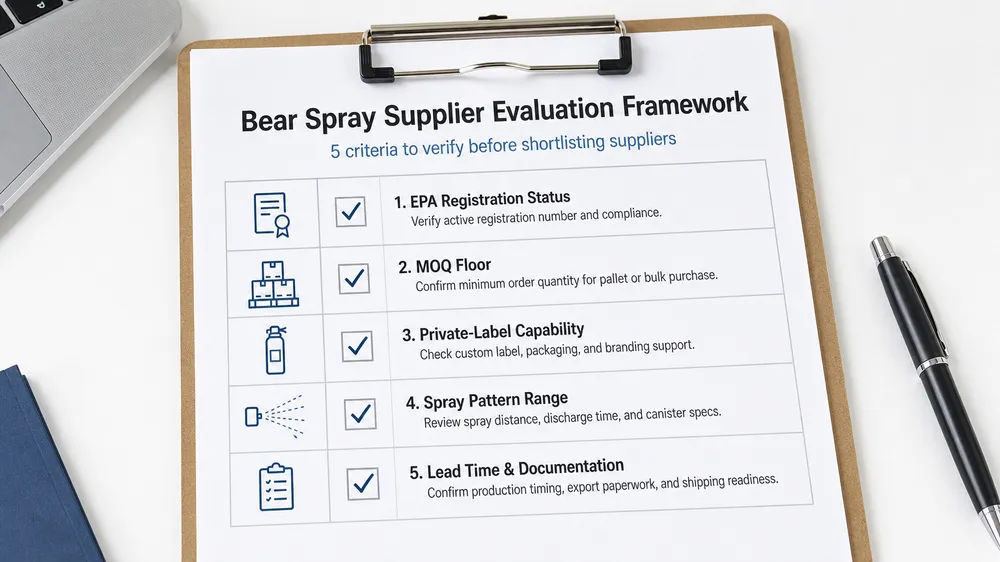
Five Criteria That Separate Serious Suppliers from Catalog Listings
Before the list, the framework. These are the five questions worth asking every supplier you're considering — and the answers will sort the field faster than any ranking.
1. EPA Registration Status
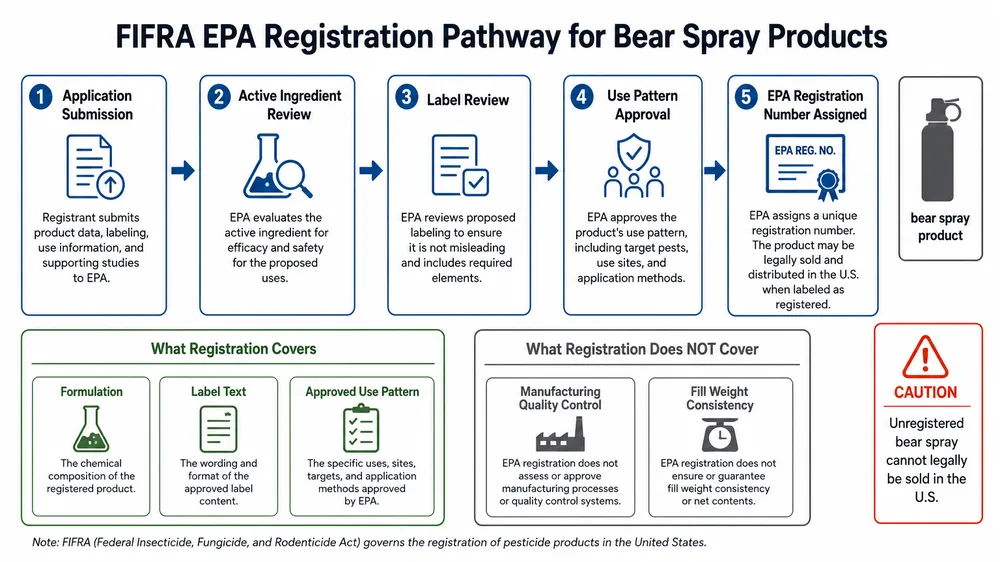
Bear spray sold in the United States must be registered with the EPA as a pesticide under FIFRA. The registration number appears on the label. If a supplier can't provide an EPA registration number for the product you're buying, you cannot legally sell it in the US market. This sounds obvious, but it's the most commonly skipped verification step in the sourcing process — especially when buyers are sourcing from overseas or from distributors who don't manufacture the product themselves.
(We see this regularly: a buyer imports a container of product, the label looks right, but the EPA registration number belongs to a different formulation or a different registrant. That's a compliance problem that lands on the importer, not the factory.)
2. MOQ Floor and Tier Structure
The published MOQ is rarely the whole story. Some suppliers list a low MOQ to attract inquiries but price small orders at a unit cost that makes them unworkable. Others have a hard floor tied to their production line minimum — below that, they're pulling from existing stock, not running your spec. Ask specifically: is this MOQ for a production run, or for a stock order? The answer changes your lead time, your customization options, and your pricing.
3. Private-Label and OEM Capability
There's a meaningful difference between a supplier who will apply your label to their existing product and a supplier who can adjust the formulation, canister format, or spray pattern to your spec. The first is label printing. The second is actual OEM manufacturing. If you're building a branded product line, you need to know which one you're dealing with — and whether the supplier has in-house formulation capability or depends on a third-party lab for any changes.
4. Spray Pattern Range
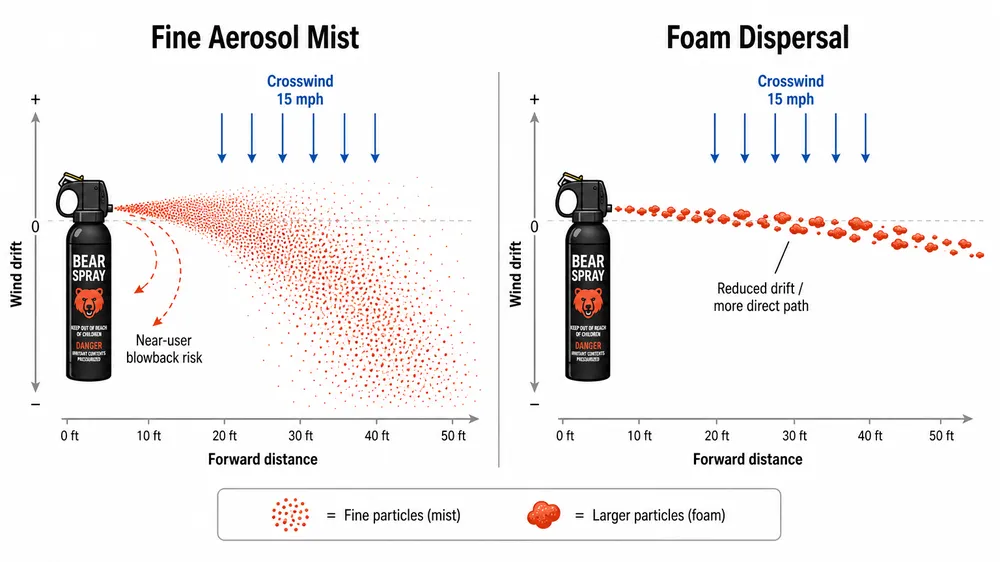
Foam, stream, and cone patterns serve different market segments and carry different regulatory and performance profiles. A supplier who only offers one pattern limits your SKU flexibility. If your distribution channel spans outdoor retail, safety equipment, and institutional buyers, you'll want a supplier who can run multiple configurations — ideally from the same production infrastructure, so your quality baseline is consistent across SKUs.
5. Lead Time and Export Documentation
For domestic distributors, lead time is usually a stock question — they either have it or they don't. For manufacturers, lead time is a production scheduling question. The documentation piece matters most for import buyers: dangerous goods classification, SDS sheets, country-of-origin documentation, and any third-party audit reports your customs broker or retail buyer will require. Ask for the documentation package before you place an order, not after.
The 10 Bear Spray Suppliers Operating in This Market
The US bear spray market is smaller and more concentrated than most buyers expect. There are a handful of actual manufacturers, a larger number of distributors and resellers, and a growing segment of private-label brands sourcing from overseas factories. Understanding which category each supplier falls into is the most important piece of context for your sourcing decision.
1. UDAP Industries
Website: udap.com | Type: Manufacturer
UDAP (Universal Defense Alternative Products) is one of the original US bear spray manufacturers, based in Butte, Montana. They manufacture their own product and hold EPA registrations for their formulations. Their flagship product, the Pepper Power bear spray, has been on the market for decades and is well-recognized in the outdoor retail channel.
For B2B buyers, UDAP is a legitimate domestic manufacturer with real production history. Their product line is relatively narrow — focused on their core canister formats — and private-label capability is limited. MOQ for wholesale accounts typically starts in the hundreds of units, though exact tiers require direct inquiry. Lead times are generally shorter than overseas sourcing for standard SKUs, which is a genuine advantage for buyers managing seasonal inventory cycles.
Sourcing fit: Outdoor retailers and distributors who need a recognized domestic brand with reliable stock availability. Less suited for buyers who need custom formulations or private-label branding.
2. Counter Assault
Website: counterassault.com | Type: Manufacturer
Counter Assault, based in Kalispell, Montana, is another established US manufacturer with EPA-registered formulations. They produce a range of canister sizes and are known for their high-concentration formulations. Their products are distributed through outdoor specialty retailers, hunting and fishing channels, and some safety equipment distributors.
Counter Assault has a longer track record in the professional and guide market — their larger canister formats are commonly specified by wilderness guides and park services. For wholesale buyers, they offer tiered pricing, though the MOQ structure and private-label availability are not publicly disclosed and require direct negotiation. Their domestic manufacturing position means shorter lead times and no import documentation complexity.
Sourcing fit: Buyers serving professional outdoor, guide, and park service segments where Counter Assault's brand recognition carries value. Custom spec work is limited.
3. Frontiersman Bear Spray (SABRE)
Website: sabrered.com | Type: Manufacturer / Brand Owner
Frontiersman is the bear spray brand under SABRE (Security Equipment Corporation), one of the largest personal safety spray manufacturers in North America. SABRE manufactures their own formulations and holds EPA registrations. The Frontiersman line is widely distributed through mass retail, outdoor specialty, and online channels.
SABRE's scale gives them distribution reach that smaller manufacturers can't match. For wholesale buyers, they offer established retail programs with planogram support and marketing materials. Private-label capability exists within SABRE's broader business, but the Frontiersman brand itself is not typically available for white-label resale. MOQ for wholesale accounts is accessible, and their supply chain is well-organized for retail replenishment.
Sourcing fit: Distributors and retailers who want a nationally recognized brand with strong retail sell-through history. Not the right fit for buyers building their own branded product line.
4. Guard Alaska Bear Spray
Website: guardalaska.com | Type: Brand / Manufacturer
Guard Alaska is an EPA-registered bear spray brand with a specific claim: it is the only bear spray registered for use on all species of bears, according to their EPA registration documentation. This is a meaningful differentiator in markets where buyers are selling to customers in grizzly country, where the species-specific claim matters.
Guard Alaska is manufactured in the US and distributed through outdoor retail and safety channels. Their product line is focused — one primary formulation in a standard canister format. For wholesale buyers, they offer distributor pricing, but the product range is narrow and private-label options are not part of their standard offering.
Sourcing fit: Buyers who specifically need the "all-species" EPA registration claim for their market positioning. Limited SKU flexibility.
5. Mace Brand (Bear Spray Line)
Website: mace.com | Type: Brand / Distributor
Mace Brand is primarily known for personal defense sprays, but they carry a bear spray line as part of their broader personal safety product portfolio. Mace products are distributed through safety equipment channels, online retail, and some outdoor specialty accounts.
For B2B buyers, Mace offers the convenience of a single-vendor relationship if you're already sourcing personal defense products from them. Their bear spray line is EPA-registered. However, Mace is primarily a brand and distribution operation — they are not a dedicated bear spray manufacturer, which means customization and private-label options are limited, and production priority for bear spray specifically may not be their core focus.
Sourcing fit: Safety equipment distributors who want to consolidate personal defense and bear spray sourcing under one vendor. Not suited for buyers who need custom specs or high-volume dedicated production.
6. Halt! Animal Repellent (PetSafe / Radio Systems Corp)
Website: petsafe.net | Type: Brand / Manufacturer
Halt! is an animal repellent spray brand under Radio Systems Corporation (PetSafe). While primarily marketed as a dog repellent, Halt! products use capsaicin-based formulations and are EPA-registered. Some distributors carry Halt! alongside bear spray in their animal deterrent category.
This is a niche entry in the bear spray supplier landscape — Halt! is not a dedicated bear spray product, and the formulation and canister specs are different from standard bear deterrent products. For buyers specifically sourcing bear spray, Halt! is not a direct substitute. It's included here because it appears in distributor catalogs alongside bear spray and buyers sometimes encounter it during sourcing research.
Sourcing fit: Animal deterrent distributors who carry a broad repellent category. Not a bear spray replacement.
7. Udap Safety Products (Wholesale / Distribution Arm)
Website: udap.com | Type: Manufacturer with Wholesale Program
Beyond their direct retail presence, UDAP operates a wholesale program for distributors and outdoor retailers. Their wholesale pricing tiers are accessible for accounts meeting minimum order thresholds, and they offer drop-ship options for some retail partners.
The distinction here is operational: buying through UDAP's wholesale program versus their retail channel gives you different pricing, different lead time commitments, and access to their full SKU range including larger canister formats not always available at retail. For buyers who want a domestic manufacturer relationship with a structured wholesale program, UDAP's wholesale arm is worth a direct conversation.
Sourcing fit: Regional outdoor distributors and buying groups who want a domestic manufacturer relationship with structured wholesale terms.
8. Defense Technology (BAE Systems subsidiary)
Website: defense-technology.com | Type: Manufacturer (Institutional / Law Enforcement)
Defense Technology manufactures a range of less-lethal products including OC (oleoresin capsicum) sprays. Their product line is primarily oriented toward law enforcement and institutional buyers rather than outdoor retail. They hold EPA registrations for their OC formulations.
For bear spray specifically, Defense Technology is not a primary supplier — their canister formats and formulations are designed for law enforcement deployment, not wildlife deterrence. However, buyers sourcing for institutional or government accounts who need a single vendor for both personal defense OC and bear deterrent products may find them worth evaluating.
Sourcing fit: Institutional and government buyers with combined OC and bear deterrent requirements. Not suited for outdoor retail or private-label programs.
9. Yellowstone Bear World / Wilderness Safety Products (Distributor)
Website: Various regional distributors | Type: Distributor / Reseller
Regional distributors serving the Rocky Mountain and Pacific Northwest outdoor markets carry bear spray from multiple manufacturers — typically UDAP, Counter Assault, and Frontiersman — and offer consolidated ordering for accounts in their territory. These distributors provide genuine value for buyers who need mixed-brand orders, regional warehousing, and shorter replenishment cycles than direct manufacturer ordering allows.
The trade-off is margin: distributor pricing adds a layer between you and the manufacturer's cost. For small accounts or buyers who need emergency replenishment, that premium is worth paying. For buyers running consistent volume, the economics of going direct to a manufacturer — domestic or overseas — typically improve at the 500-unit-per-order threshold and above.
Sourcing fit: Small-to-mid accounts in bear country regions who need flexible replenishment and mixed-brand ordering. The distributor premium is the cost of that flexibility.
10. Sabre Red (Wholesale / OEM Division)
Website: sabrered.com | Type: Manufacturer with OEM Capability
SABRE's broader manufacturing operation — beyond the Frontiersman retail brand — includes OEM and private-label capability for qualified buyers. SABRE manufactures personal safety sprays at scale and has the formulation infrastructure to support custom concentration and canister format work for buyers who meet their volume thresholds.
For bear spray specifically, SABRE's OEM program is worth exploring if you need a US-manufactured private-label product and can meet their MOQ requirements, which are typically higher than overseas factory minimums. Their EPA registration infrastructure and domestic manufacturing position simplify the compliance side of a private-label program. The unit cost will be higher than factory-direct overseas sourcing, but the regulatory pathway is more straightforward.
Sourcing fit: Buyers who specifically need US-manufactured private-label bear spray and can meet higher MOQ thresholds. The domestic manufacturing premium is the cost of that compliance simplicity.
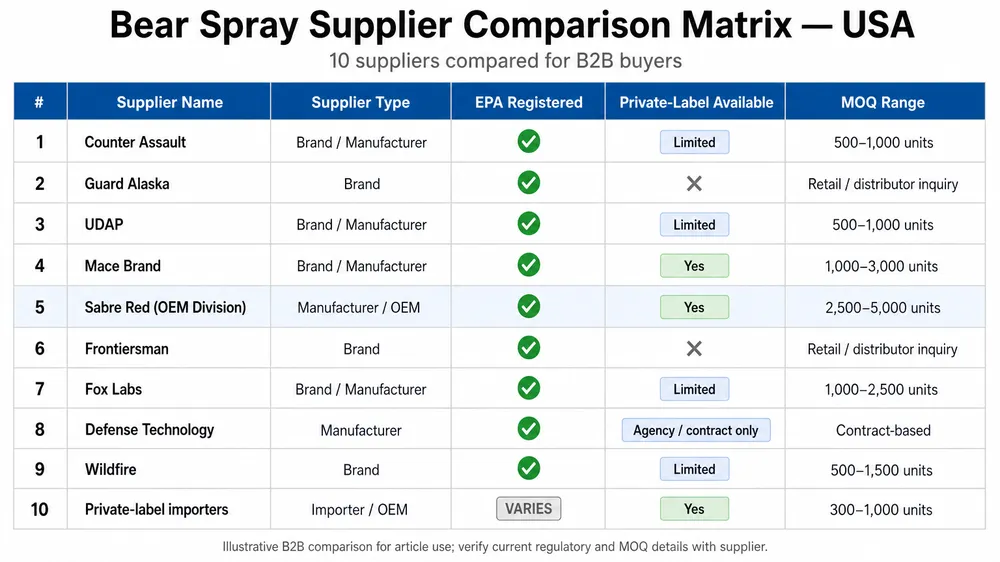
Supplier Comparison: MOQ, Private-Label, and EPA Status at a Glance
| Supplier | Type | EPA Registered | Private-Label | MOQ Range |
|---|---|---|---|---|
| UDAP Industries | Manufacturer | Yes | Limited | ~100–500 units |
| Counter Assault | Manufacturer | Yes | Limited | ~100–500 units |
| Frontiersman (SABRE) | Manufacturer / Brand | Yes | No (brand) | Retail program |
| Guard Alaska | Manufacturer / Brand | Yes | No | ~100+ units |
| Mace Brand | Brand / Distributor | Yes | No | Distributor MOQ |
| Halt! (Radio Systems) | Brand / Manufacturer | Yes | No | Not bear spray |
| UDAP Wholesale | Manufacturer | Yes | Limited | ~200+ units |
| Defense Technology | Manufacturer (LE) | Yes | No | Institutional |
| Regional Distributors | Distributor | Via brand | No | Flexible |
| SABRE OEM Division | Manufacturer | Yes | Yes | High (US mfg) |
The pattern in this table is worth noting: most US-based suppliers are either brand owners who don't offer private-label, or distributors who add a margin layer without adding manufacturing capability. The suppliers who do offer OEM or private-label work — primarily SABRE's OEM division — carry higher MOQ thresholds and unit costs that reflect domestic manufacturing economics.
Where Local Supply Adds Real Value
Local sourcing from US-based manufacturers and distributors has genuine advantages that are worth acknowledging before you run the cost comparison.
Replenishment speed. If you're managing a retail account with unpredictable sell-through — a regional outdoor chain, a park service gift shop, a hunting and fishing retailer — the ability to reorder 200 units and receive them in two weeks is worth something. No import lead time, no customs clearance, no container minimum.
Emergency stock. Seasonal demand spikes in bear country are real. If you're caught short in June and need product by July 4th weekend, a domestic distributor can solve that problem. A factory in Asia cannot.
Compliance familiarity. US manufacturers have already navigated EPA registration, FIFRA labeling requirements, and state-level restrictions. When you buy from a domestic manufacturer, you're buying a product that has already cleared those hurdles. The compliance risk sits with the manufacturer, not with you as the importer.
Relationship continuity. For buyers who value a phone call over an email thread, domestic suppliers offer communication in the same time zone, in the same language, with the same regulatory context. That has operational value, especially for buyers who are new to the category.
Where the Local Premium Compresses Your Margin
The honest trade-off: domestic manufacturing economics in the US mean higher unit costs than factory-direct overseas sourcing at equivalent volume. That premium is real, and it compounds across your supply chain.
A US-manufactured bear spray canister at wholesale typically runs in the range of $8–$14 per unit depending on size, formulation, and order volume. Factory-direct pricing from a dedicated overseas manufacturer at 1,000+ units runs materially lower — the gap widens as volume increases. At 5,000 units, the landed cost difference (including freight, duties, and documentation) can represent 30–50% of your unit cost, which translates directly into margin or competitive pricing room.
The private-label gap is even wider. US-based OEM programs for bear spray carry high MOQ thresholds — typically 2,000–5,000 units minimum for a custom label run — and unit costs that reflect domestic labor and overhead. Factory-direct OEM from a dedicated manufacturer can run custom formulations and private-label programs at lower MOQ thresholds and significantly lower unit costs, with the trade-off being longer lead times and the import documentation burden sitting on your side.
(The documentation burden is real but manageable. Dangerous goods classification, SDS sheets, and EPA registration verification are not complicated if your supplier provides a complete file. The buyers who struggle with import compliance are usually the ones who didn't ask for the documentation package before placing the order.)
The Distributor vs. Manufacturer Distinction — Why It Matters for Your Margin
Several entries in this list are distributors or brand owners, not manufacturers. That distinction has direct commercial implications.
A distributor buys from a manufacturer, marks up, and resells. You're paying for their inventory carrying cost, their warehousing, and their margin. For small orders and emergency replenishment, that's a fair trade. For repeat volume, you're paying a permanent premium for a service you may not need.
A manufacturer controls the production process, the formulation, and the cost structure. When you buy direct from a manufacturer — domestic or overseas — you're buying at a lower point in the supply chain. The savings are real, and they scale with volume.
The more important distinction for buyers considering private-label or OEM work: a distributor cannot customize the product. They can apply a label to an existing SKU, but they cannot adjust the capsaicin concentration, change the spray pattern, or modify the canister format. For that, you need a manufacturer with in-house formulation capability.
SOHAPI as a Factory-Direct Alternative for Custom-Spec and Volume Buyers
We've covered the US landscape honestly. Now the direct question: where does a factory-direct overseas manufacturer fit into this picture, and when does it make commercial sense?
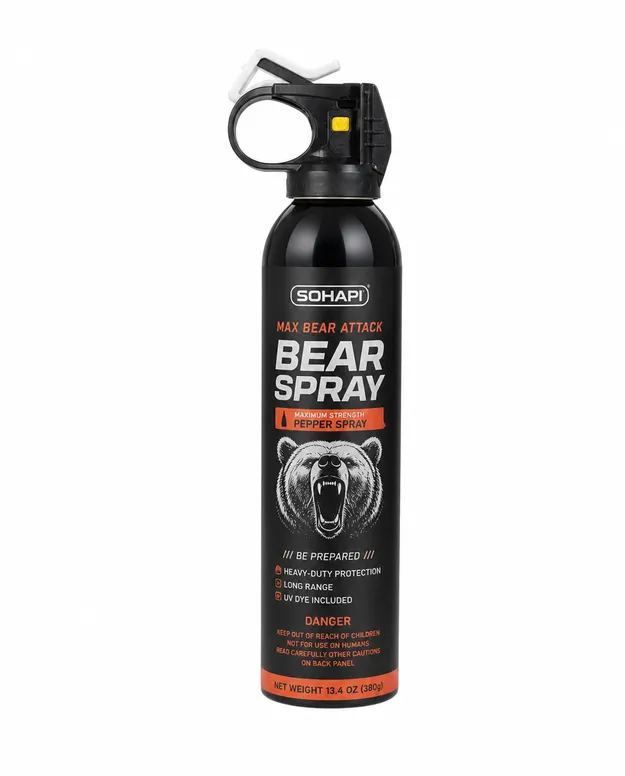
SOHAPI is a dedicated bear spray manufacturer based in Japan, operating since 2010. We're not a general aerosol factory that added bear spray to the catalog — this is the only product category we build. 15,000 square meters, 8 production lines, 200 employees, 500,000 units annual capacity. ISO 9001:2015, CE, and SGS certified.
The "dedicated manufacturer" distinction matters more than it sounds. At a general aerosol factory, your bear spray order competes for production time with deodorant, insecticide, and industrial spray runs. Line changeovers introduce fill-weight drift. QC protocols are generalized, not calibrated to the specific failure modes of pressurized capsaicin canisters. We've seen the output from those facilities — it shows up in fill weight variance and valve crimp inconsistency that doesn't surface until the product is in your customer's hands.
Our filling line runs automated gravimetric control to ±1g tolerance across the full production run. Every crimped canister goes through a 100% water bath leak test — not statistical sampling, every unit. We run HPLC testing on every incoming capsaicin batch to verify concentration before it enters the production floor. These aren't marketing claims; they're the process steps that prevent the specific failure modes that generate returns and compliance problems in this product category.
For OEM & ODM bear spray manufacturing, our in-house R&D team handles formulation development directly — no third-party lab dependency. Custom capsaicin concentration, carrier viscosity adjustment for foam vs. stream vs. cone pattern, canister format changes — these are standard project types for us. Most custom formulation projects run 4–6 weeks from spec to approved sample. Trial orders run through the same production line and QC process as full production runs, so what you test is what you scale.
On the documentation side: ISO 9001:2015, CE, SGS audit reports, dangerous goods classification for DOT and IATA, SDS sheets, and country-of-origin documentation are all part of our standard export file. Your customs broker gets a complete package, not a back-and-forth for missing paperwork.
For buyers considering bear spray private label, the economics work differently than domestic OEM. Our MOQ for private-label programs is flexible — trial orders are available, and the unit cost at 1,000+ units is materially lower than US-manufactured equivalents. The trade-off is lead time (25–35 days for standard SKUs from order confirmation, longer for custom formulation projects) and the import documentation responsibility sitting on your side. For buyers running consistent volume on a planned procurement cycle, that trade-off is straightforward.
The buyers who get the most value from a factory-direct relationship are the ones who have moved past emergency replenishment mode — who are planning 90-day inventory cycles, building a branded product line, or sourcing for a distribution program where unit cost and margin control matter more than two-week replenishment windows.
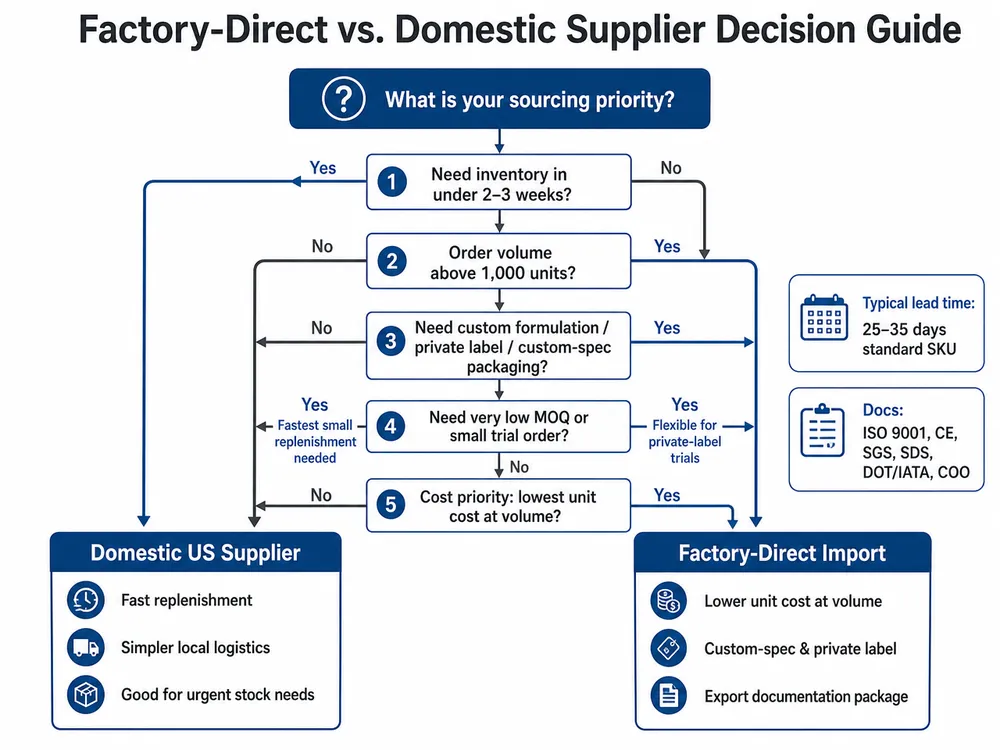
Which Sourcing Route Fits Your Situation
The right answer depends on your order profile, not on a ranking.
Local domestic supplier is the right call when:
- You need product in under 3 weeks
- Your order volume is under 200 units per cycle
- You're managing unpredictable seasonal demand with no forward planning window
- You need a recognized US brand name for your retail channel
- You're new to the category and want to minimize import compliance complexity
Factory-direct import makes commercial sense when:
- You're running planned procurement cycles of 90 days or longer
- Your per-order volume is 500 units or above
- You need custom formulation, spray pattern, or canister format
- You're building a private-label product line and need margin room to support your retail pricing
- You want a supplier who can scale with your volume without production priority conflicts
The hybrid approach — domestic distributor for emergency replenishment, factory-direct for planned volume — is what most serious distributors in this category end up running. It's not either/or. The domestic relationship covers your short-cycle needs; the factory-direct relationship covers your cost structure on the volume that actually moves your margin.
How to Structure an RFQ for a Bear Spray Supplier
Whether you're approaching a domestic manufacturer or a factory-direct overseas supplier, the quality of your RFQ determines the quality of the response you get back. A vague inquiry gets a vague quote. A specific inquiry gets a price you can actually use.
Include these elements in your RFQ:
- Canister size and fill weight target — 7.9 oz, 10.2 oz, or custom. Fill weight in grams.
- Capsaicin concentration target — expressed as % CRC (capsaicinoids). EPA minimum for bear spray is 1.0% CRC; most US retail products run 1.0–2.0%.
- Spray pattern — foam, stream, or cone. If you don't have a preference, say so and ask for the supplier's recommendation by channel.
- Annual volume estimate — even a rough number (500 units/year vs. 5,000 units/year) changes the pricing tier and the conversation about MOQ.
- Private-label requirement — yes or no. If yes, specify whether you need label-only or full formulation customization.
- Target market — US retail, institutional, export. This affects EPA registration requirements and documentation needs.
- Lead time requirement — your planning cycle and any hard delivery deadlines.
For EPA-registered bear spray specifically, ask the supplier to confirm the EPA registration number for the exact formulation you're buying — not a related product, the specific SKU. This is the single most important compliance verification step for US market entry.
Frequently Asked Questions
What is the minimum order quantity for bear spray wholesale in the USA?
It varies significantly by supplier type. Domestic distributors often have no hard MOQ — they'll sell you a case of 12. Domestic manufacturers typically start wholesale accounts at 100–500 units. Factory-direct overseas manufacturers run production-based MOQs that depend on their line minimums; for a dedicated bear spray manufacturer, trial orders in the 200–500 unit range are common, with full production runs starting at 1,000+ units. The key question is whether you're ordering from stock or triggering a production run — the answer changes your lead time and your customization options.
Does bear spray sold in the USA need to be EPA registered?
Yes. Bear spray is regulated as a pesticide under FIFRA (Federal Insecticide, Fungicide, and Rodenticide Act) and must carry an EPA registration number on the label. The registration covers the specific formulation — concentration, active ingredient, and intended use. Importing or selling bear spray without a valid EPA registration number is a federal violation. When sourcing from overseas, the importer of record is responsible for ensuring the product meets EPA registration requirements before it enters the US market. See our detailed guide on EPA-registered bear spray for the full verification checklist.
What capsaicin concentration should I specify when sourcing bear spray for US retail?
EPA requires a minimum of 1.0% CRC (capsaicinoids) for a product to be labeled as bear spray. Most US retail products run between 1.0% and 2.0% CRC. The practical ceiling is around 2.0% — above that, you're not adding meaningful deterrence performance, and you're increasing the regulatory scrutiny on the formulation. For most retail channels, 1.3–1.8% CRC is the standard range. If you're sourcing for a premium or "maximum strength" positioning, 2.0% CRC is the typical spec. Ask your supplier for HPLC test results on the specific batch you're buying — not a spec sheet claim, actual test data.
Can I source private-label bear spray from a US manufacturer?
Yes, but the options are limited and the MOQ thresholds are higher than overseas factory programs. SABRE's OEM division is the most accessible US-based option for private-label bear spray. Domestic private-label programs typically require 2,000–5,000 units minimum and carry unit costs that reflect US manufacturing economics. Factory-direct overseas OEM programs offer lower MOQ thresholds and lower unit costs, with the trade-off being longer lead times and import documentation responsibility. For buyers building a branded product line with planned volume, the overseas factory-direct route typically offers better margin economics. For buyers who specifically need US-manufactured product for their retail channel requirements, domestic OEM is the right path despite the higher cost.
What documentation do I need to import bear spray from overseas?
The core documentation package for importing bear spray into the US includes: EPA registration verification for the specific formulation, SDS (Safety Data Sheet) for the aerosol product, dangerous goods classification documentation (DOT for ground/ocean, IATA for air), certificate of origin, and the standard commercial invoice and packing list. Your customs broker will handle the import entry, but they need the complete documentation file from your supplier before the container ships. Suppliers who are experienced with US import will have this package ready — if a supplier can't produce it on request, that's a signal worth taking seriously. Our Bear Spray product pages include the certification and documentation details for SOHAPI's export program.