
Range is the first number buyers ask about when specifying a stream bear spray SKU. It's also the number most likely to mislead them. A supplier quotes "9 meters" on a spec sheet, the buyer locks in the order, and the product that arrives performs at 6 meters under real conditions. The gap isn't fraud — it's a measurement convention problem that most supplier spec sheets never explain.
This guide covers what bear spray stream range actually means as a documented spec, how discharge rate connects to it, what drives consistency across a production run, and what to ask a supplier before you commit to a stream configuration.
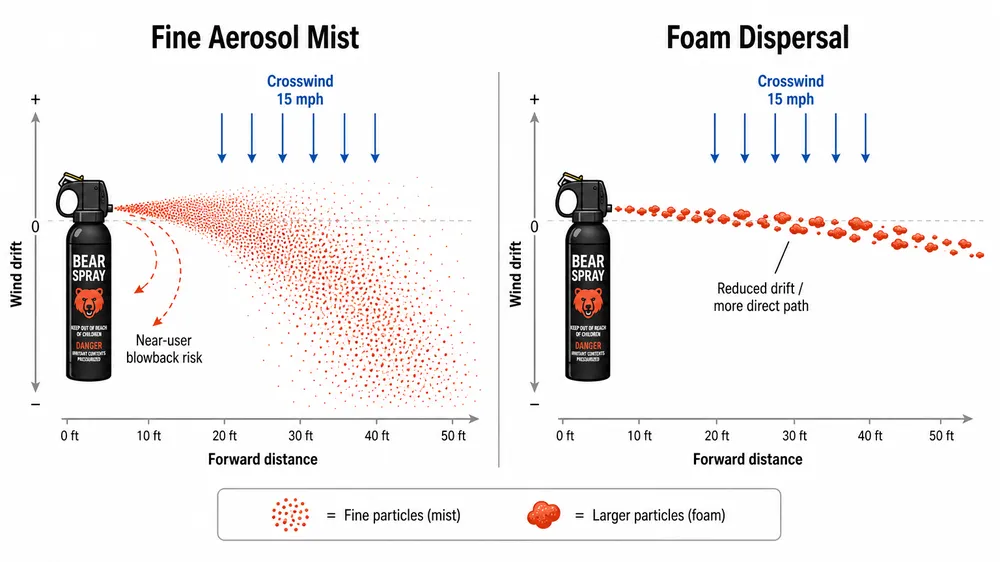
If you're comparing stream against other spray patterns first, the bear spray foam vs stream comparison covers that trade-off in detail.
Effective range vs. maximum range: the spec sheet distinction that matters
Most bear spray spec sheets list a single range figure. What they don't say is whether that number is maximum range or effective range — and the difference is significant when you're writing product claims for retail packaging or responding to a buyer's RFQ.
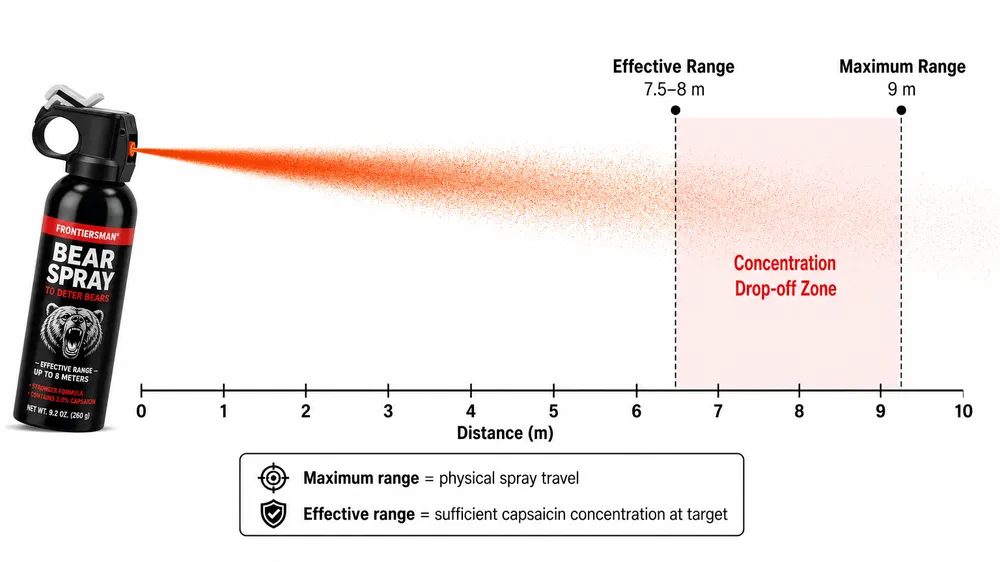
Maximum range is the distance the spray stream physically travels before it loses coherence and disperses. Under controlled lab conditions with no wind, a well-formulated stream canister can reach 9–10 meters. That's the number that tends to appear on spec sheets.
Effective range is the distance at which the spray delivers sufficient capsaicin concentration to function as a deterrent. In field conditions — light wind, ambient temperature variation, a user who isn't holding the canister at a perfect angle — effective range is typically 1–2 meters shorter than maximum range. For a canister rated at 9 meters maximum, effective range in real use is closer to 7–8 meters.
The EPA's minimum range requirement for registered bear spray is 7.62 meters (25 feet). That's a minimum effective range standard, not a maximum range claim. A product that hits 9 meters maximum but only 6 meters effective doesn't meet the threshold.
When you're reviewing a supplier's spec sheet, ask which measurement convention they're using. If they can't answer that question, the number on the sheet is probably maximum range measured under ideal lab conditions — and your retail packaging claims need to reflect effective range.

The four variables that determine stream range
A range number on a spec sheet is the output of four interacting variables. Understanding them tells you whether a supplier's claimed range is achievable across a full production run — or just a best-case sample result.
Propellant pressure drives the initial velocity of the spray stream. Higher pressure means longer reach, but it also affects discharge rate — more on that below. Propellant ratio (the percentage of propellant relative to the total fill weight) is set during formulation and must stay consistent across every canister in a batch. A batch where propellant ratio drifts by even 3–4% will show measurable range variance.
Valve orifice diameter controls how the pressurized contents exit the canister. A larger orifice increases discharge rate and can extend range, but it also reduces total spray duration for a given fill weight. Stream configurations use a narrower orifice than cone patterns — that's what gives the stream its directional coherence and longer reach. The orifice is set by the valve specification, and it doesn't change during production. What can change is valve-to-valve dimensional consistency, which is why valve sourcing and incoming inspection matter.
Carrier viscosity affects how the capsaicin solution behaves once it exits the valve. A lower-viscosity carrier produces a finer, faster-moving stream that travels farther before dispersing. A higher-viscosity carrier produces a heavier stream that drops sooner. We tune carrier viscosity during formulation development — it's one of the adjustments we make when an OEM buyer needs to hit a specific range target for a particular canister size.
Fill weight is the variable most buyers overlook. A canister that's 5% underfilled has less propellant driving the spray, which means lower pressure at the valve and shorter range — especially toward the end of the discharge. Fill weight tolerance across a production run directly affects range consistency. This is why our automated gravimetric fill control, which holds every canister to ±1g of target weight, isn't just a QC metric — it's what makes the range spec on your product label defensible across the full batch, not just the first few units off the line.
(We rebuilt our filling line around gravimetric control early on, after seeing fill weight drift cause range variance in a production run. The fix was infrastructure, not process tweaks.)
Discharge rate: what grams per second means for your sourcing decision
Discharge rate is the speed at which the canister contents are expelled, measured in grams per second (g/s). It's a spec that most buyers don't ask about — and it's one of the more commercially relevant numbers on a stream bear spray spec sheet.
Here's why it matters for sourcing:
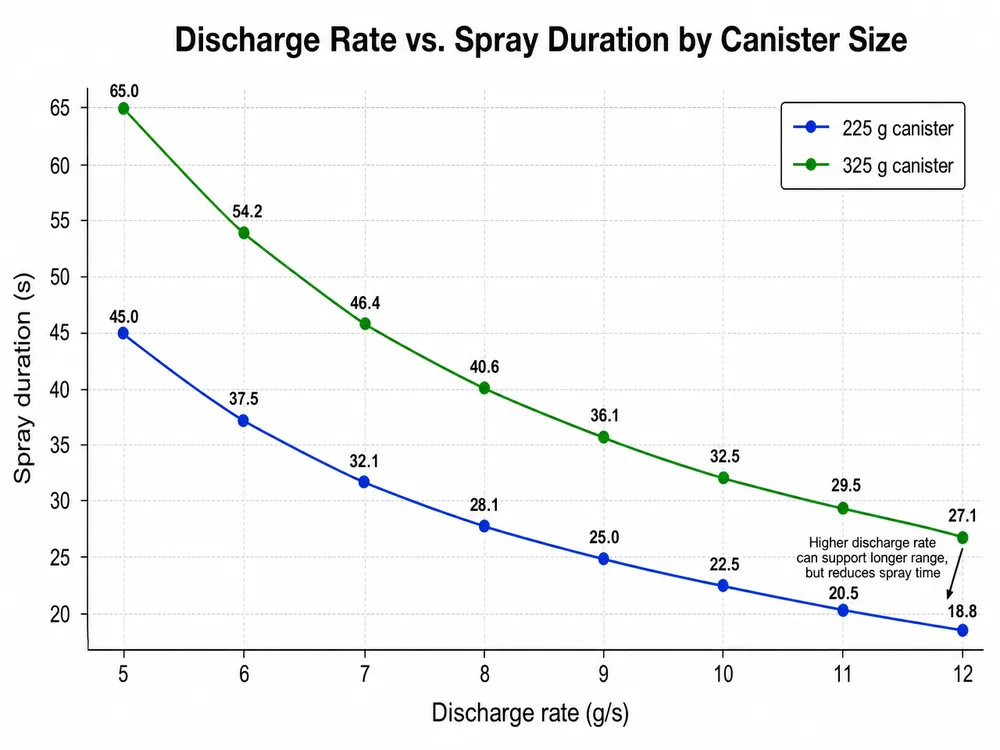
A 225g canister with a discharge rate of 7.5 g/s delivers approximately 30 seconds of total spray time. The same canister with a discharge rate of 10 g/s delivers about 22 seconds. Both canisters have the same fill weight. Both can claim the same range. But the product with the higher discharge rate depletes faster, which affects how your downstream customers experience the product — and how you position it against competitors on shelf.
Discharge rate also interacts with range. Higher discharge rate generally supports longer range because more propellant is moving through the valve per second, maintaining pressure longer. But it comes at the cost of spray duration. The trade-off is a formulation decision, and it should be documented in the spec sheet you receive from your supplier.
The EPA doesn't specify a minimum discharge rate for bear spray, but it does require that the product deliver sufficient capsaicin concentration at the minimum effective range. A canister with a very low discharge rate may technically reach 7.62 meters but deliver insufficient concentration at that distance to meet the efficacy standard. This is a compliance risk that doesn't show up in a simple range test.
For buyers specifying MOQ across multiple canister sizes — say, a 150g travel SKU and a 325g full-size SKU — discharge rate is the variable that determines whether both products feel consistent to the end user. We typically tune discharge rate separately for each canister format rather than using a single valve spec across the range, because the pressure dynamics are different at different fill weights.
Spray pattern comparison: stream vs. cone vs. foam across range, discharge rate, and wind sensitivity
Stream is one of three primary spray pattern configurations in bear spray. The table below covers the key spec differences relevant to sourcing decisions.
| Spec | Stream | Cone | Foam |
|---|---|---|---|
| Typical effective range | 7–9 m | 5–7 m | 4–6 m |
| Discharge rate | Moderate–high (7–10 g/s typical) | High (9–14 g/s typical) | Low–moderate (5–8 g/s typical) |
| Wind sensitivity | Low–moderate | High | Low |
| Spray duration (225g) | 22–30 sec | 15–22 sec | 28–38 sec |
| Directional accuracy | High | Low | Moderate |
| Blowback risk | Low | High | Very low |
| Primary market fit | Open terrain, long-distance encounters | Dense brush, close encounters | High-wind environments |
Stream's range advantage over cone comes from the orifice geometry and carrier viscosity — the stream exits as a coherent jet rather than a dispersed cloud, so it maintains concentration over distance. The trade-off is that stream requires more accurate aim than cone, which matters for how you position the product in your distribution channel.
For a deeper comparison of stream and foam across wind resistance and blowback risk, see bear spray foam vs stream. For valve-level engineering detail on what controls stream pattern consistency, bear spray stream valve engineering covers that specifically.
How production consistency determines whether your range spec holds across a batch
A supplier can produce a sample canister that hits 9 meters. The question is whether unit 4,800 in your order performs the same as unit 1.
Three production variables determine batch-level range consistency:
Fill weight tolerance. We've covered this above, but it's worth being direct: ±1g gravimetric fill control is the standard we hold on every line, every run. Most aerosol manufacturers work to ±3–5g tolerances. At ±5g on a 225g canister, you have a 2.2% fill weight variance — enough to produce measurable range differences between units at the low end of the tolerance band. If a supplier can't tell you their fill weight tolerance, assume it's wider than you'd want.
Valve crimping consistency. The crimp seal between the valve and the canister body determines the internal pressure the canister maintains over its shelf life. An under-crimped valve leaks slowly — the canister that's been sitting in a warehouse for 18 months has lower pressure than the one that shipped last week, and lower pressure means shorter range. We use automated crimping equipment calibrated to the valve manufacturer's torque specifications, and every crimped canister goes through a water bath leak test before it moves to labeling. That's not a statistical sample — it's 100% of units.
Propellant ratio control. Propellant is blended into the formulation at the filling stage. If the propellant ratio drifts during a long production run — which happens when filling equipment isn't properly calibrated or when the propellant supply pressure varies — the canisters filled at the start of the run will have different range characteristics than those filled at the end. We run propellant ratio checks at the start of each shift and after any line interruption. It's a 10-minute check that prevents a container of out-of-spec product.
The practical implication for buyers: when you're evaluating a supplier's range claim, ask for discharge rate data from final outgoing inspection, not just a sample test result. A supplier who runs discharge rate measurement at final inspection has production-level data. A supplier who only tests samples has sample-level data — and those are different things.
Regulatory context: EPA range requirements in sourcing language
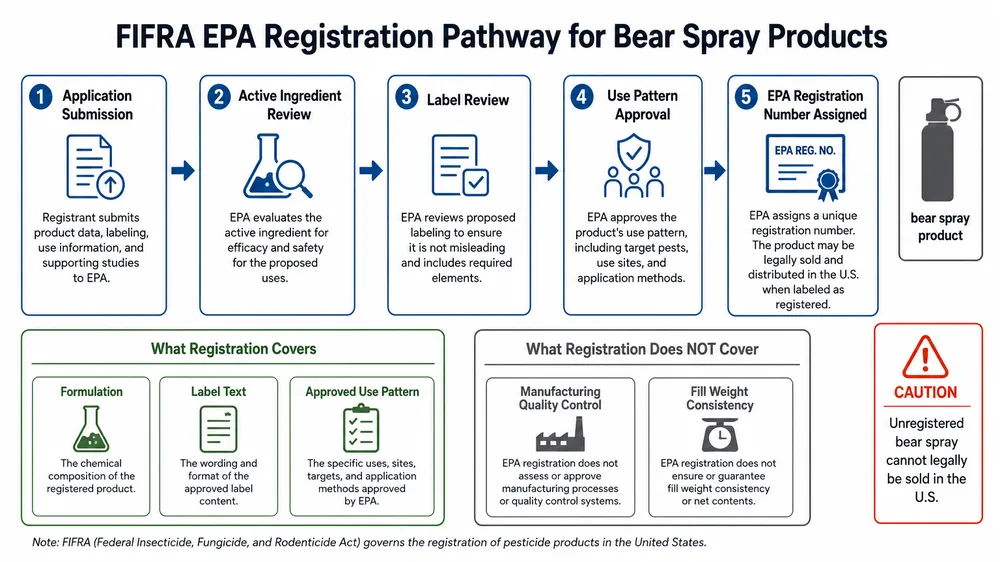
The EPA registers bear spray as a pesticide under FIFRA (Federal Insecticide, Fungicide, and Rodenticide Act). For a product to be sold as bear spray in the US market, it must meet minimum performance standards, including a minimum spray range of 7.62 meters (25 feet).
That 7.62-meter figure is an effective range requirement — the product must deliver deterrent-level capsaicin concentration at that distance, not just physically reach it. This distinction matters when you're reviewing a supplier's EPA registration documentation or writing product claims for US retail packaging.
A few sourcing implications:
- If a supplier's spec sheet lists range as "7.5 meters," that product may not meet the EPA minimum under real-use conditions. The margin is too thin. Specify a minimum effective range of 8 meters or above to give yourself compliance headroom.
- EPA registration is product-specific, not factory-wide. A factory can be ISO 9001 certified and still supply you with a formulation that isn't EPA-registered. Verify the registration number for the specific SKU you're ordering, not just the factory's general credentials.
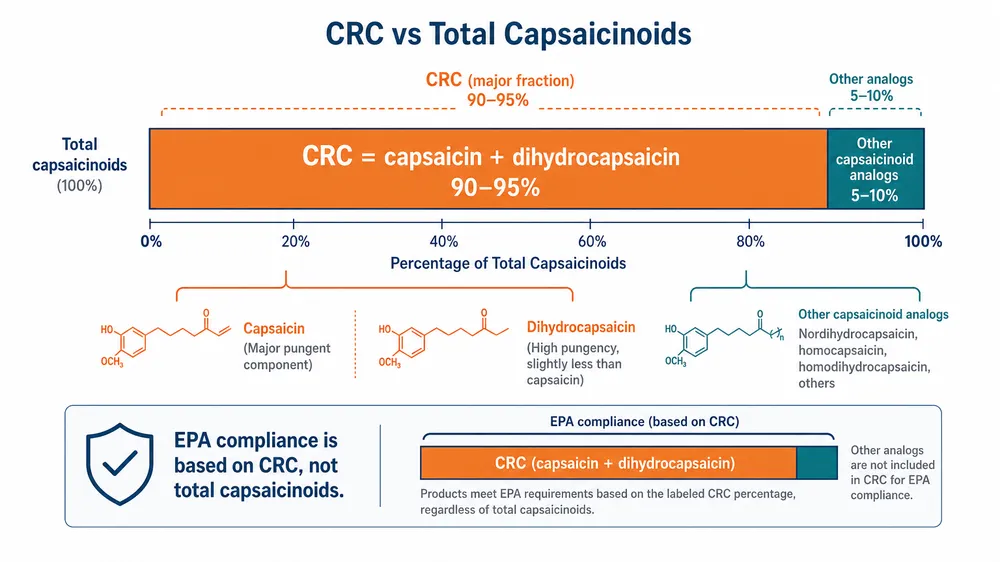
- Private-label buyers who modify the formulation — changing capsaicin concentration, carrier chemistry, or propellant ratio — may need to re-register the product with the EPA. This is a common oversight in OEM sourcing that adds months to a product launch timeline.
(We've walked buyers through this process more than once. The EPA registration path for a modified formulation isn't complicated, but it has a timeline, and it needs to start before you finalize the product spec — not after.)
What to ask a supplier about stream range specs before you commit
Most sourcing conversations about bear spray stream range focus on the peak number. These are the questions that actually tell you whether the spec is real and repeatable:
1. Is the range figure on your spec sheet maximum range or effective range? If they can't distinguish between the two, the number is probably maximum range under ideal conditions.
2. What is your fill weight tolerance across a production run? ±1g is tight. ±5g is loose. Anything wider than ±3g on a 225g canister will produce range variance you'll see in field returns.
3. What is the discharge rate for this SKU, and how is it measured? Ask for grams per second, not a qualitative description. Ask whether it's measured at the start of discharge, mid-discharge, or as an average — these give different numbers.
4. Do you run discharge rate measurement at final outgoing inspection? This tells you whether the supplier has production-level data or only sample-level data.
5. What valve specification are you using, and who is the valve supplier? Valve orifice diameter is the primary determinant of discharge rate and stream pattern. A supplier who can answer this question has control over their supply chain. One who can't is probably assembling from whatever valve stock is available.
6. Can you provide batch records or QC data from a recent production run? A supplier with a real QC system can pull this. It doesn't need to be a full MTC — a discharge rate log and fill weight log from a recent batch is sufficient to verify that the production process is controlled.
7. What is the EPA registration number for this specific formulation? Not the factory's general certifications — the registration number for the SKU you're buying.
These questions separate suppliers who have documented production control from those who have a good sample and a confident sales team. The answers also tell you whether the range spec on your product label is defensible if a downstream customer or regulator asks for it.
For buyers ready to specify a stream SKU with documented range and discharge rate performance, the Bear Spray Stream product page covers our standard configurations. If you need a custom range target or a specific discharge rate for a private-label project, send us an RFQ with your canister size, target market, and range requirement — we'll provide a spec sheet and sample for evaluation.
Frequently asked questions
How far does bear spray stream reach in meters? A well-formulated stream bear spray reaches 7–9 meters effective range under typical field conditions. Maximum range under controlled lab conditions can reach 9–10 meters. The EPA minimum for registered bear spray is 7.62 meters effective range. When reviewing supplier specs, confirm which measurement convention the range figure represents.
What discharge rate should I specify for a long-range stream bear spray? For a 225g canister targeting 8+ meters effective range, a discharge rate of 7.5–9 g/s is a reasonable target. Higher discharge rates (10+ g/s) can extend range but reduce total spray duration. The right number depends on your canister size and how you're positioning the product — a longer-duration product and a longer-range product are different formulation decisions.
Does fill weight tolerance affect bear spray stream range? Yes, directly. A canister at the low end of a wide fill weight tolerance band has less propellant, lower internal pressure, and shorter range — particularly toward the end of the discharge. Specify fill weight tolerance in your RFQ and ask for gravimetric fill control documentation. ±1g tolerance is achievable with automated gravimetric equipment; ±5g is a sign of manual or poorly calibrated filling.
What is the EPA minimum range requirement for bear spray? 7.62 meters (25 feet) effective range. This is a minimum, not a target. Products that barely clear this threshold have no compliance margin for production variance or real-use conditions. Specify 8 meters or above as your sourcing minimum.
Can a supplier tune discharge rate for a specific canister size? Yes, through valve orifice selection and propellant ratio adjustment. A supplier with in-house R&D capability can hit a specific discharge rate target for a given canister format. This matters when you're specifying multiple SKUs and want consistent performance characteristics across your product line.
What documents should I request to verify stream range performance? At minimum: a spec sheet with effective range and discharge rate clearly stated, fill weight tolerance documentation, and discharge rate data from final outgoing inspection. For US market products, the EPA registration number for the specific formulation. SGS audit reports are available from us on request for buyers who need third-party documentation for import clearance.